
In China’s regulatory system, almost every material fact about a company leaves a documentary trail: a licence, registration certificate, quality certificate or patent filing. This investigation follows that trail for JIMON GROUP (金木集团有限公司, Jinmu Group Co., Ltd.) and asks one central question: what does each document actually prove, and what remains outside its scope?
I reviewed publicly available Chinese government registers, the direct-selling system of the State Administration for Market Regulation (SAMR), databases of the National Medical Products Administration (NMPA), commercial company-information services Qichacha and Tianyancha, the company’s own website and Chinese business media. The main conclusion is straightforward: the documentary record is real and can be checked, but every document proves only what it says. Understanding that boundary matters more than collecting impressive-looking certificates.

How to read the documents: a guide for the reader
Before opening the first register, I set a simple rule: documents in the Chinese legal system have different evidentiary weight. A corporate registration record confirms that a legal entity exists; it does not certify the quality of its products. A direct-selling licence authorises a particular business model; it does not establish product effectiveness. A patent protects a technical solution; it is not proof of a therapeutic effect. A medicine registration issued after a regulator’s review carries a different kind of weight, but it remains limited to the product, indications and jurisdiction covered by the registration.
For that reason, this is not a list of “achievements”. It is a route through different document types—from corporate registration to sector licences, product registrations, patents and international approvals. At every step, I distinguish three questions: what the document establishes, what it cannot establish, and where a reader can check it independently.
First trail: the legal entity in the public register
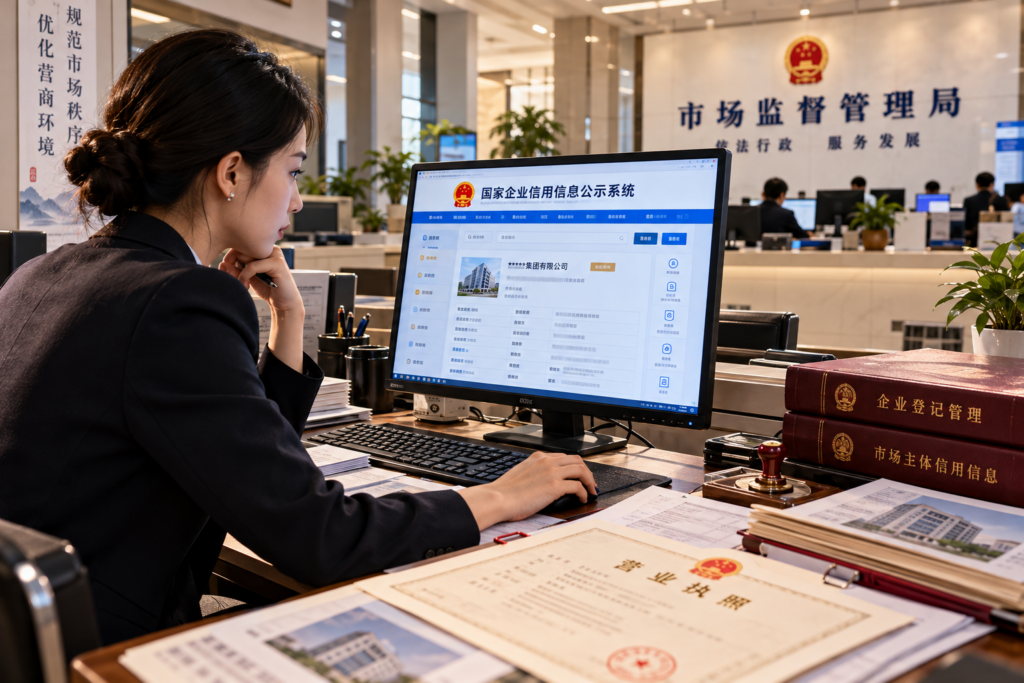
Checking a Chinese company begins with its unified social credit code, a broad identifier comparable to a tax or company number. Corporate-information services Qichacha and Tianyancha, which draw on China’s National Enterprise Credit Information Publicity System, list the active legal entity 金木集团有限公司 (Jinmu Group Co., Ltd.) as registered in 2004 in Anguo, Hebei Province. Before 2016, it was named 河北金木药业集团有限公司 (Hebei Jinmu Pharmaceutical Group). See the Qichacha company recordqcc.com and Baidu Baike entrybaike.baidu.com. Public biographical sources identify Niu Liwei (钮立卫) as the legal representative and chairman; see Baidu Baike Englishbaike.baidu.com.
The company presents 1993 as its founding year in official materials Jinmu Group official websitejinmujituan.cn. The registry, however, records the registration of the current legal entity in 2004. In Chinese corporate histories, these dates can refer to different events: the start of a founder’s business activity and the legal registration of the entity that exists today. The company associates the 1993 date with the Anguo Zhonghualu medicinal-plaster factory, described as a predecessor of the group; the latter detail is also reported in the Baidu Baike English entrybaike.baidu.com.
I do not treat the difference as a contradiction that automatically calls for a “revelation”. It is important to understand that a registry date and a company’s stated founding date answer different questions. The registry supports the existence of the current legal entity in Anguo and its recorded name history. It does not by itself prove business scale, product quality or the start of commercial activity in 1993; that earlier date relies on the company’s historical materials and other sources.
Second trail: the direct-selling licence
Among the group’s documents, the direct-selling business licence (直销经营许可证) is relatively straightforward to check because China maintains a central government system for licensed direct-selling companies. 金木集团有限公司 appears among the licensed businesses in the State Administration for Market Regulation’s register. The register can be searched through the SAMR direct-selling information systemzxjg.samr.gov.cn.
Reports published at the time identify 19 November 2015 as the date the licence was obtained. See China Economic Netfinance.ce.cn and China.com Financefinance.china.com.cn. Direct selling is a licensed activity in China and appears on the country’s negative list for market access: the 2025 list prohibits the activity without the required permission 2025 Negative List for Market Access, item 206005swj.baoji.gov.cn. Reports also describe a required security deposit of CNY 20 million as part of the licensing framework.

The licence matters because it documents permission to use a specific distribution model under Chinese law. Its limits matter just as much: the licence is issued under Chinese jurisdiction. It does not automatically authorise direct selling in Russia, Kazakhstan or any other country where the group operates. Each market has its own legal requirements.
Third trail: NMPA registration certificates for medicines
Product registration records are a different class of evidence. NMPA records and company or industry publications refer to roughly 300 product approval or registration numbers associated with the group’s businesses. Each number relates to a particular product and regulatory status; it should not be treated as a single blanket authorisation for an entire catalogue.
These entries can support a claim that a named product has passed the relevant regulatory process described in its record. They do not, by themselves, establish that a product works for every person, is suitable for every condition, or has the same legal status outside China. The registered indication, manufacturer, formulation and current status must be checked for each product in the NMPA’s official resourcesnmpa.gov.cn.
A related claim concerns China’s National Essential Medicines Catalogue, which informs routine procurement by public medical institutions. Corporate channels reported that 98 products from subsidiaries were included in the draft for the 2026 edition Sohu reportsohu.com. The catalogue itself is a government document National Health Commission catalogue documentnhc.gov.cn, but the exact count of group products in the draft should be treated as a corporate-source claim unless independently reconciled line by line against the official list.

Fourth trail: the GMP certificate and its expiry date
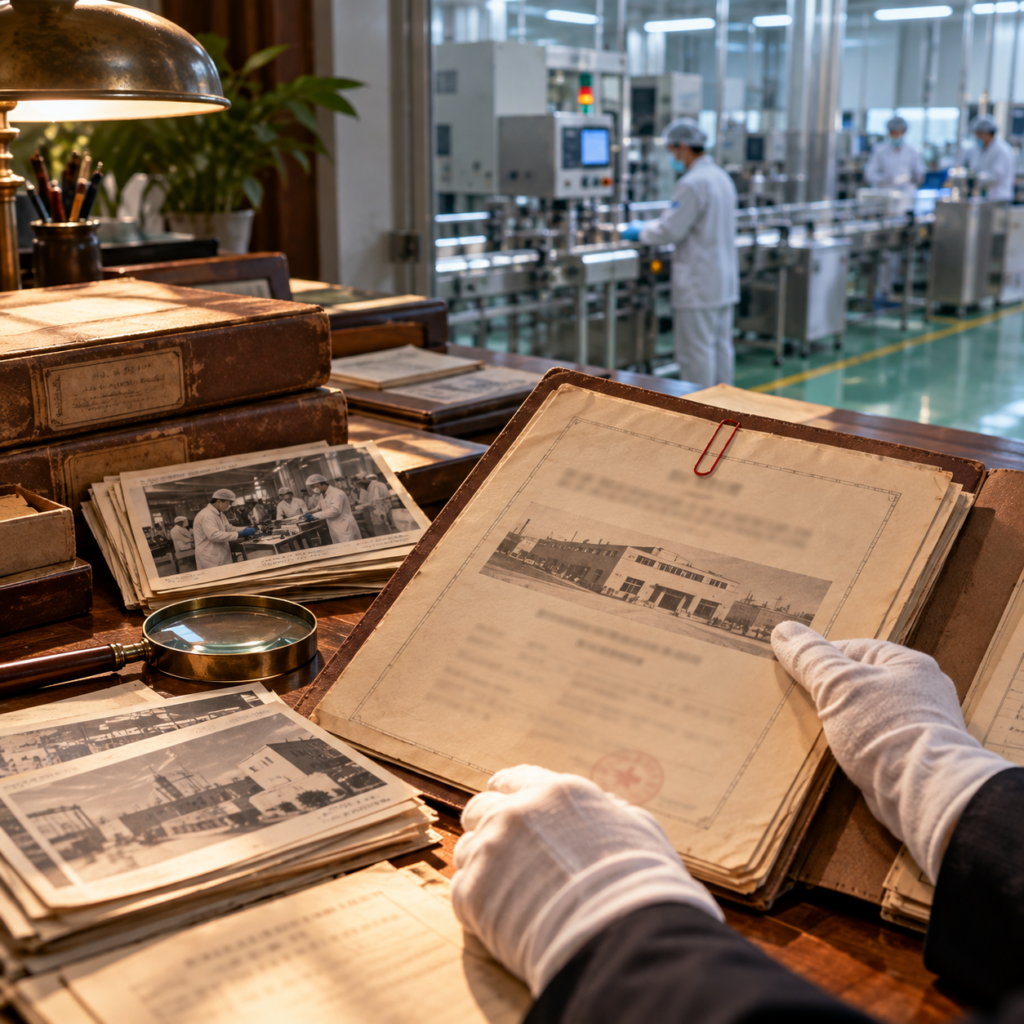
The NMPA archive contains a 2015 GMP certification announcement from the Hebei provincial food and drug authority. It lists certificate HE20150019, issued to 保定中药制药有限公司 (Baoding Traditional Chinese Medicine Pharmaceutical Co., Ltd.) at No. 8 Jinmu Street, in Anguo’s Traditional Chinese Medicine Industrial Park. The certified production forms included tablets, capsules, granules, pills, syrups and tinctures. The certification date was 15 February 2015, with validity through 14 February 2020. See the NMPA notice, HE2015 No. 4nmpa.gov.cn.
This is a useful example of how to read a certificate. It confirms that the facility underwent government GMP certification at that time. The specific certificate’s stated validity ended in 2020. Following China’s 2019 regulatory reforms, GMP inspections became part of ongoing manufacturing supervision rather than relying solely on separate five-year certificates. Therefore, an expired historic certificate is not, by itself, an accusation of non-compliance—but neither is it proof of current status. Current production status should be checked against up-to-date manufacturing licences and NMPA records, not inferred from an archived certificate.
The same caution applies to management-system certificates. Industry publications, including Consumer Daily, have reported ISO 9001 and ISO 22000 certifications for group enterprises Consumer Daily reportccn.com.cn. Readers can check a specific certificate through the public search platform of China’s Certification and Accreditation Administration CNCA certification searchcx.cnca.cn. By contrast, I have not independently verified the company’s reported CNAS laboratory accreditation in the public register. That point remains marked as requiring a direct lookup by registration number. An explicit gap in the evidence is more useful than a confident but unverified statement.
Fifth trail: registrations in other countries
One of the less familiar documentary layers for international readers concerns product registrations outside China. A report in Hebei Daily dated 22 July 2026 described three developments: Hydnocarpus seed oil being sold in Singapore and Malaysia; nine products, including Angong Niuhuang and Xihuang preparations, receiving registration certificates from Canada’s health authority; and more than 50 products undergoing halal certification in Indonesia. See the Hebei Daily report carried by Tencent Newsnews.qq.com and Hebtv coveragehebtv.com.

Industry reports list Canadian registrations for products including Xihuang Wan, Danshen tablets and Angong Niuhuang Wan from several group businesses, including Baoding Traditional Chinese Medicine, Yubentang and Hebei Anguo Pharmaceutical Sohu industry reportsohu.com. Canada classifies these products under its Natural Health Products (NHP) framework, which requires pre-market review and an NPN product number overview of the NHP/NPN frameworkicgzx.com.
An NPN is evidence of a Canadian regulatory step for the particular product; it does not turn that product into a prescription medicine under Canadian law, cover the company’s entire portfolio, or establish its regulatory position in Russia. Likewise, halal certification addresses compliance with halal standards for ingredients and production. It can be important for market access, but it is not a test of clinical effectiveness.
Sixth trail: patents—what they protect and what they do not prove
The most common misunderstanding about patents is to treat them as a seal of quality. A patent grants an exclusive right over a qualifying technical invention or solution. It reflects a patent office’s assessment against legal criteria such as novelty and inventive step; it does not establish clinical effectiveness, product superiority or commercial success.
The sources reviewed describe a patent portfolio associated with the group, with counts ranging from roughly 56 to 71 depending on the database, date and method of counting. Patent families, applications, granted patents and records held by different group entities are not always counted in the same way. A meaningful review therefore needs the publication number, applicant, status, claims and filing history for each patent—not only a headline total. Relevant starting points include the China National Intellectual Property Administration (CNIPA)cnipa.gov.cn and patent-information services such as PatSnap.

A patent may show that an organisation has developed and sought protection for a technical solution. It does not substitute for clinical trials, a product registration, manufacturing oversight or evidence about outcomes in people. Those are separate questions requiring separate evidence.
Seventh trail: public awards and institutional designations
Some official documents record recognition rather than permission. In December 2025, Hebei Province announced the recipients of its 13th Government Quality Award. 金木集团有限公司 appeared among the ten organisational recipients, alongside major industrial businesses in the province (People.com.cn, Hebeihe.people.com.cn; Phoenix Hebeihebei.ifeng.com). This provincial recognition relates to quality management at the enterprise level.
Other designations reported by sources include national high-tech enterprise status (国家高新技术企业), inclusion on Hebei’s list of leading agricultural industrialisation enterprises under government document Jizhengzi No. 37 of 2023 text of the government documentabeedata.com, and research infrastructure associated with the group. Industry reports describe a Hebei medicinal raw-material research institute within the group from 2015 and an academic workstation established in 2016 with a team led by academician Li Liangda Changcheng Net / Ifeng reportinews.ifeng.com. The existence of Jinmu’s academic workstation as an innovation platform is also mentioned in an official Hebei industry-department report on Anguo’s industrial park Hebei Department of Industry and Information Technologygxt.hebei.gov.cn.
The evidentiary boundary remains clear. An award for quality management is not a certificate for every product. An academic workstation is not a guarantee that a particular capsule is effective. These documents describe the organisation’s institutional position within quality-management, research and agricultural-policy systems, not the clinical performance of each item in its catalogue.
Evidence map: what each document type establishes
- What it can establish
- Existence of the current legal entity; 2004 registration in Anguo; recorded name history through 2016
- What it does not establish
- Business activity from 1993, company scale or product quality
- Where to check
- Qichacha; Tianyancha
- What it can establish
- Permission for the licensed direct-selling model in China
- What it does not establish
- Legal authorisation in countries outside China
- Where to check
- SAMR direct-selling system
- What it can establish
- Regulatory status of the specific registered product
- What it does not establish
- Effectiveness beyond approved indications or blanket approval of the entire catalogue
- Where to check
- NMPA database
- What it can establish
- That the facility underwent GMP certification at the time stated
- What it does not establish
- Current manufacturing status
- Where to check
- NMPA archive; current manufacturing licences
- What it can establish
- Protection of specified technical solutions under the stated patent claims and status
- What it does not establish
- Clinical effectiveness or commercial success
- Where to check
- CNIPA; patent databases
- What it can establish
- Pre-market review for the particular products with NPN numbers
- What it does not establish
- Prescription-drug status in Canada or coverage of all products
- Where to check
- Health Canada NPN database
- What it can establish
- Compliance with halal requirements within the certification’s scope
- What it does not establish
- Clinical effectiveness
- Where to check
- BPJPH register
- What it can establish
- Recognition of enterprise-level quality management
- What it does not establish
- Quality or effectiveness of each individual product
- Where to check
- Published government award decision
What remains outside the documents
A serious evidence map must show what is not yet filled in. Three claims could not be fully matched to independently verifiable records in this review. I record them as open questions, not as disproven claims.
The first is the historical depth of 450, 357, 305 and 125 years attributed to acquired businesses. For Baoding Traditional Chinese Medicine Pharmaceutical, a documentary lineage can be traced through several milestones: Wan Bao Tang pharmacy in 1876; a Baoding branch of Lerentang in 1936; a cooperative workshop in 1956; and Baoding Pharmaceutical Factory in 1958 (Sina, Baodingtj.sina.cn; Baidu Baikebaike.baidu.com). That is roughly 150 years of traceable continuity—significant in its own right.
The deeper histories of other heritage brands—Yubentang, Yishoutang and Anyao—still rely primarily on corporate material Sohu reportsohu.com. Independent archival reconstruction of those histories remains a separate research task, partly explored in the English article on JIMON GROUP’s history.
The second open question is CNAS laboratory accreditation: the status requires a direct registry search by accreditation number, which I could not identify in the public materials reviewed. The third concerns the precise scale and legal status of the group’s cultivation base. Published aggregate figures vary between sources and refer to different years.
The methodological lesson is simple: documentary evaluation depends not on the number of certificates, but on the exact match between a document, a factual claim and the boundary of what that document establishes. Corporate registration, the Chinese direct-selling licence, product registration records, archived and current NMPA materials, international registrations and public awards can be checked against official or published sources. Statements that still require direct verification are not automatically scandals; they define the edge of current knowledge and point to the next research task.
Final synthesis
Following the documentary trail makes it possible to answer the initial question more precisely. JIMON GROUP’s certificates, patents and official records support three broad conclusions.
First: the group operates through a verifiable legal and manufacturing system, with a registered legal entity, a licensed direct-selling model in China and a regulatory history visible in NMPA materials.
Second: the product portfolio is associated with regulatory registrations, rather than relying on marketing statements alone. The numbers cited in company and industry sources—around 300 Chinese registration records, nine Canadian registrations and more than 50 Indonesian halal certifications—must still be interpreted product by product and within each regulator’s scope.
Third: the research and manufacturing infrastructure—including an industry research institute, an academic workstation and a patent portfolio—is described in provincial and national materials.
What these documents do not establish is that every product will be effective for every person, that every claimed heritage date has been equally independently documented, or that Chinese licences automatically apply abroad. These boundaries are not a weakness in the picture; they are the frame that makes it honest. The next natural research question concerns the group’s internal structure: which legal entities sit behind particular registration numbers, and how responsibilities are divided among the businesses with long histories. That is the next pass through the registers.

If you have a document that could refine this map—a certificate scan, a registry extract or an archive page concerning one of the heritage brands—please share it with the author. One page of primary evidence can advance an investigation more than ten paragraphs of assumptions. Deeper reviews of patent families, Canadian NPN numbers and the history of Wan Bao Tang are developed in the research space “Laboratory of Algorithms”, where materials are examined against primary sources.
Editorial note: This article is an independent investigation. This website is not an official representative of JIMON GROUP. Statements are distinguished as documented facts, company claims, third-party reporting or author analysis. This material is for informational purposes and is not medical, legal or investment advice.
Research keys
Browse the topic archives for this article.