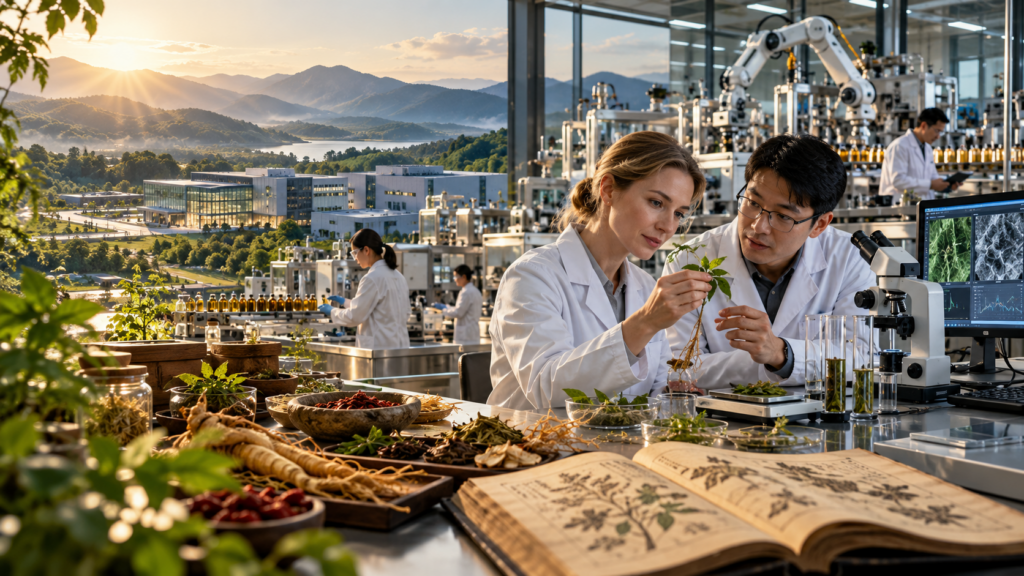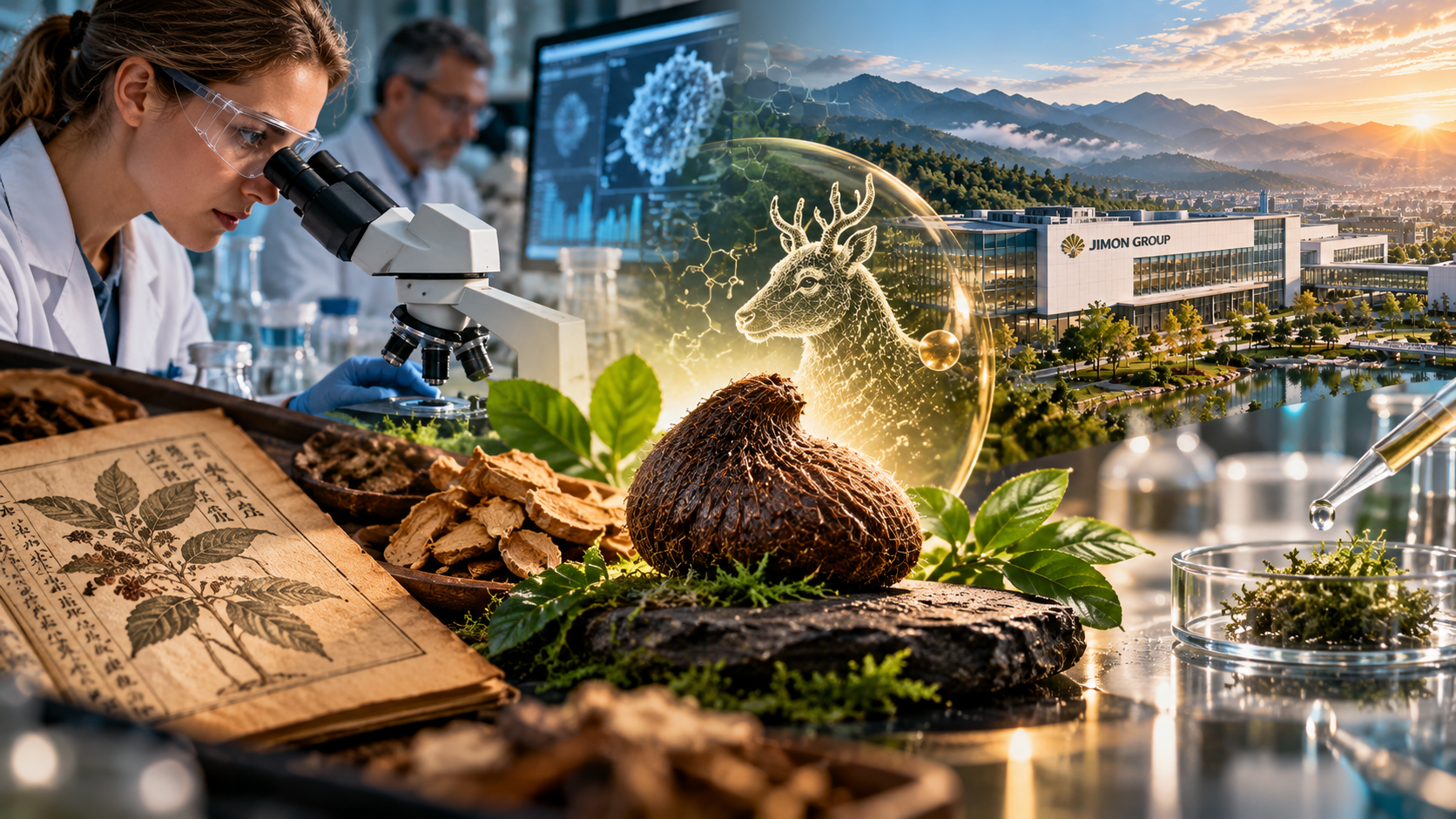
In August 2025, a paper in an international journal published by Springer examined microbial communities associated with natural musk. It is a specialised subject, and a reader might skim past the “Materials and Methods” section. Yet that section contains a detail worth pausing over: the muskrats used in the experiment were purchased from Jinmu Technologies, a company in Xinji, Hebei, associated with JIMON GROUP. In this study, a traditional Chinese medicine manufacturer appears not as the sponsor of a promotional article, but as a supplier of biological material for scientific research.
That brief line in another team’s methods section became the starting point for this investigation. The wider question is: what does JIMON GROUP’s research infrastructure actually consist of, and how does scientific work become part of the company’s products?
I reviewed company announcements, Chinese government and industry sources from 2024–2026, and scientific papers that mention companies in the group. The short answer is that JIMON’s products are supported by a multi-level research system: an academic workstation, a provincial research institute, joint laboratories with leading universities, and a strategic partnership with Shanghai-based SUPER LAB. One important limitation should be made clear from the outset: many figures describing the scale of this activity come from the company itself. Wherever that is the case, the source status is stated explicitly.

One detail that opens up the system: musk as a scientific problem
Let us return to musk. It is not an incidental detail, but an entry point into a wider area of the group’s work.
Natural musk is one of the scarce ingredients used in traditional Chinese medicine. It appears in classical formulas, including “Angong Niuhuang Wan” and “Suhexiang Wan.” Industry sources have described a long-running shortage of quality raw material. A scarce ingredient is not only a commercial problem; it is also a scientific one: how can musk deer be bred, how can raw-material quality be standardised, and how can the properties of a natural component be reproduced consistently?
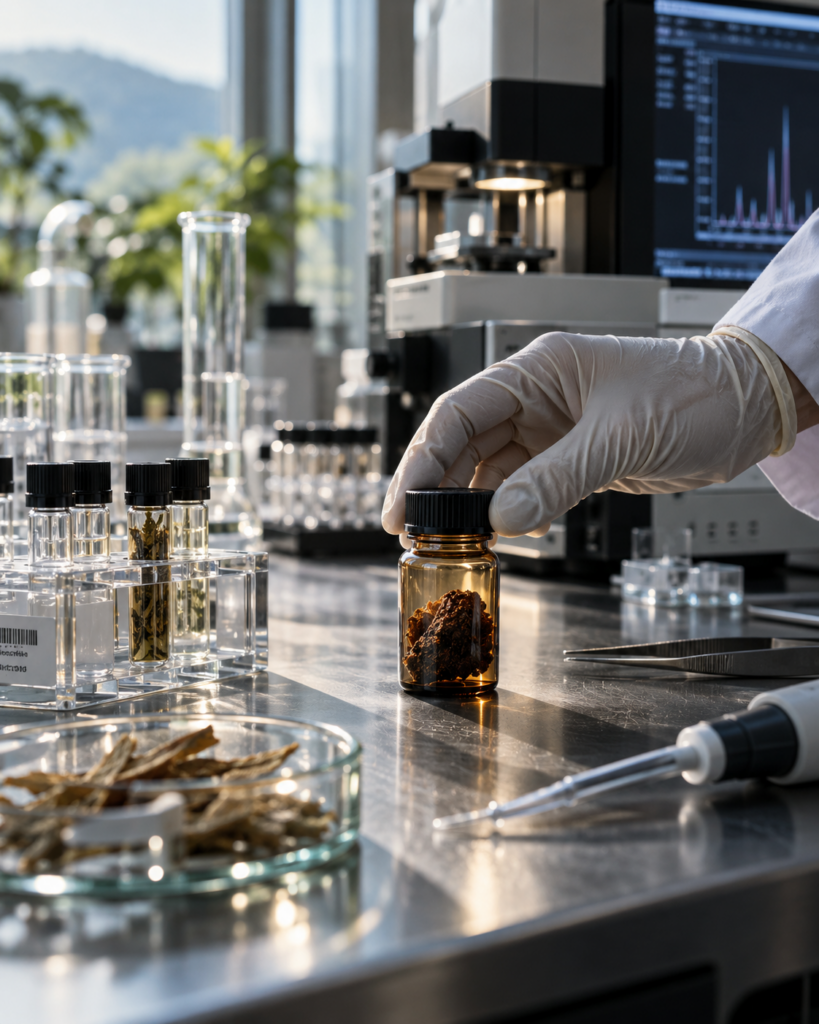
On 20 July 2026, JIMON GROUP’s headquarters hosted the signing of an agreement to establish a joint “Institute of Natural Musk Technology” with the Qinghai New Silk Road Hui Medicine Research Institute. The project was presented as a full-cycle platform encompassing musk-deer breeding bases, the development of new medicines, and a joint testing laboratory. At the signing ceremony, the Qinghai institute’s director, Tan Qilong, also highlighted the development of quality standards for musk and for characteristic medicinal plants from Qinghai.
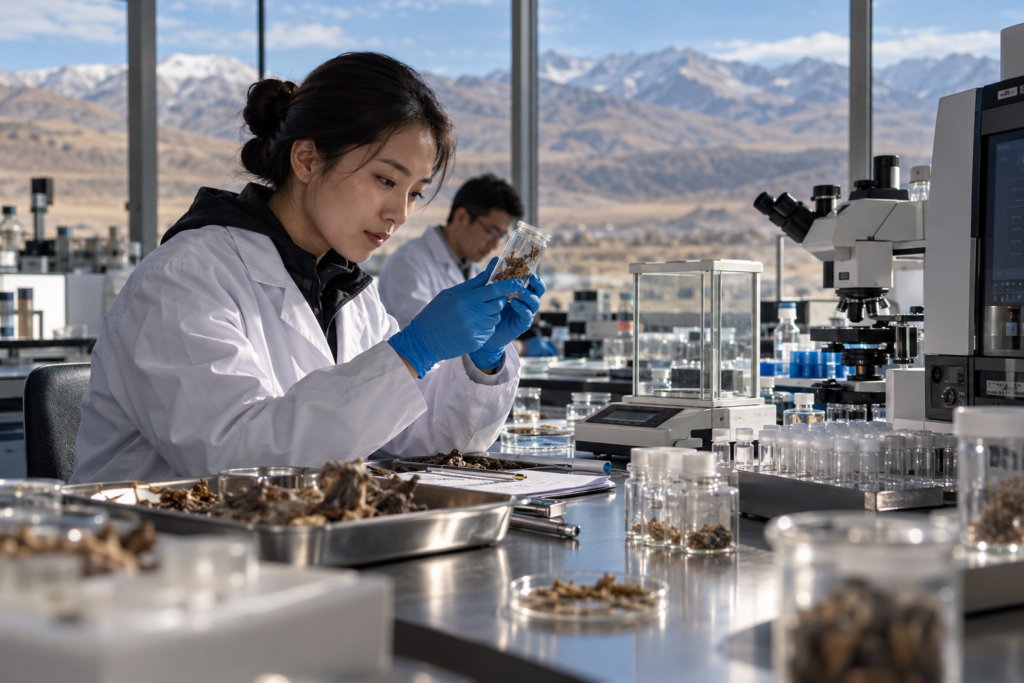
The status of this information matters. The agreement and its date are reported by several independent industry publications. Its future effectiveness, however, cannot yet be assessed: the institute was created recently, so results are not yet available. The careful conclusion is that the intention and organisational structure have been documented, not the outcomes.
This connects the institute with the Springer study mentioned at the beginning. A company investing in scientific work on musk and establishing a specialised institute is also supplying biological material for independent research in the same field. That is more than a promotional gesture; it suggests that knowledge about an ingredient is being treated as part of the production strategy.
How the research system is organised: five levels
Industry reviews published in 2026 describe JIMON GROUP’s research and development as a five-level system. It can be considered from the highest level of scientific expertise down to the company’s internal research function.
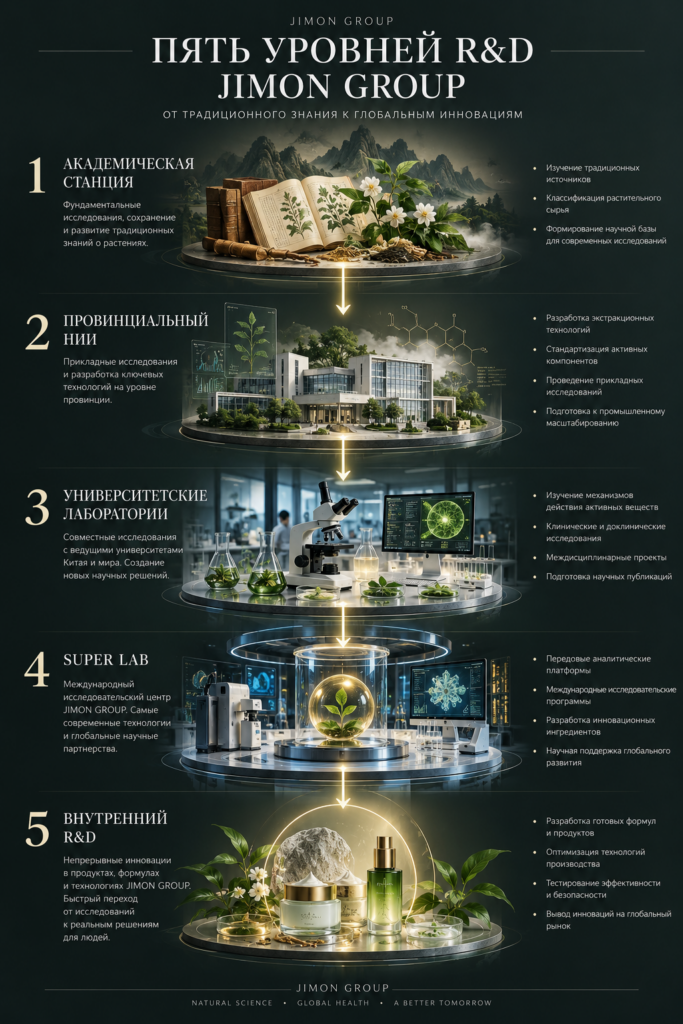
- Academic workstation. The “Jinmu academician workstation” (金木院士工作站) operates in the traditional Chinese medicine industrial park in Anguo, where the group’s headquarters is located. Its existence is mentioned by the Hebei provincial government portal among the park’s innovation platforms, alongside the Beijing–Tianjin–Hebei TCM industry innovation alliance. In China, an academician workstation is a formal mechanism for a company to work with an academician’s research team; it is more than an honorary sign or plaque.
- Provincial research institute. Industry publications report the presence of the Hebei Institute of Industrial Technology for Medicinal Raw Materials, established with a leading role by the group. This level focuses on industry-wide tasks: processing technologies, raw-material standards and control methods.
- University laboratories. The group is reported to work on an ongoing basis with more than ten research and educational organisations, including the China Academy of Chinese Medical Sciences, Tianjin University of Traditional Chinese Medicine, Zhejiang University, Hebei Medical University and Hebei University of Chinese Medicine. Formats include joint laboratories, staff-training bases and collaborative research projects.
- Advanced laboratory in Shanghai. JIMON has announced strategic cooperation with the scientific team at Shanghai’s SUPER LAB. According to the company’s official website, the focus includes biosynthesis technologies and environmentally friendly organic raw materials. This is a COMPANY CLAIM, attributed to the company rather than presented as independently established fact.
- Internal research centre. The research centre at the group’s headquarters in Anguo completes the chain from research to product development and manufacturing.
One point is easy to overlook: the system is not simply a collection of occasional contracts. The levels are intended to connect with one another. The academic workstation helps set the research agenda; the provincial institute addresses industry problems; universities contribute specialist expertise; the Shanghai partnership adds a biotechnology component; and the internal centre translates results into formulas and manufacturing procedures. The degree of connection between these levels—not merely their number—is the important indicator of whether a research system is mature.
Academician Zhang Boli and a project described as an example of “new productive forces”
The top level merits a closer look because it involves a specific scientist.
Zhang Boli is an academician of the Chinese Academy of Engineering, a recipient of the “Master of National Medicine” title, honorary president of Tianjin University of Traditional Chinese Medicine, and editor-in-chief of the Tianjin Journal of Traditional Chinese Medicine. During the COVID-19 pandemic, he led a national TCM medical team in Wuhan and is among the most prominent scholars in the field. Industry publications describe long-term strategic cooperation between JIMON GROUP and his research team, while government sources record his role as an adviser on development of the Anguo industrial park.
In May 2024, Zhang Boli visited JIMON GROUP’s stand at the 11th National Conference on the Joint Development of Medicinal Raw-Material Bases in Tianjin. The visit was reported by China Daily, a state-owned English-language publication. During the visit, the academician discussed the cultivation and processing of medicinal raw materials with group chairperson Niu Liwei and, especially relevant to this research, the “secondary development” of classical formulas.
He also mentioned a joint project involving Tianjin University of Traditional Chinese Medicine, Zhejiang University and Baoding Chinese Medicine Pharmaceutical Co., a JIMON GROUP subsidiary. The project investigated the material basis and mechanism of action of Guanxinjing capsules for ischaemic heart disease. It offers a useful case study of how research can be connected to a product.
The Guanxinjing case: how a classical formula undergoes secondary development
“Secondary development” (二次开发) is an important term in modern Chinese pharmaceuticals. It describes returning to an existing medicine used in clinical practice with modern scientific tools: identifying its chemical composition, investigating its mechanisms of action, improving manufacturing technology and standardisation. The idea is to move a traditional formula beyond the assertion that it works because it has been used for centuries, towards a clearer understanding of what it contains and how it may act.
In 2025, a team involving Tianjin University of Traditional Chinese Medicine, the State Key Laboratory of Component-based Chinese Medicine, the First Teaching Hospital of Tianjin University of Traditional Chinese Medicine and Baoding Chinese Medicine Pharmaceutical (a JIMON GROUP company) published a paper in the Tianjin Journal of Traditional Chinese Medicine titled “Analysis of the Chemical Composition of Guanxinjing Based on UPLC-Q-TOF-MS/MS Technology.” The paper is reported as indexed in CNKI, China’s principal academic literature database.

UPLC-Q-TOF-MS/MS stands for ultra-performance liquid chromatography coupled with tandem mass spectrometry and a time-of-flight analyser. Put simply, the method helps researchers separate a complex plant-based medicine into its chemical components and identify individual compounds and their structures. For traditional medicine, this is significant because a formula containing many ingredients becomes less of a “black box.”
According to the study description, the analysis identified multiple components and described a multi-component, multi-target pattern involving several signalling pathways. The authors connected this to the formula’s traditional description of helping to clear the vessels, support qi, activate blood and resolve stasis. The researchers reported plans to continue work on pharmacological mechanisms and clinical evaluation.
The boundary of interpretation must remain explicit. This was an analytical and mechanistic study of chemical composition, not a clinical trial of efficacy. It supports the conclusion that modern analytical methods were used to characterise the product and that its components were discussed in terms of possible biological mechanisms. It does not, by itself, establish clinical effectiveness in patients; that requires different kinds of studies. Separating these levels of evidence—composition, mechanisms and then clinical evaluation—is essential to a scientific assessment and is the sequence described for the team’s further work.
What does this case show about JIMON GROUP? A subsidiary took part as a co-author alongside a specialised university and a state key laboratory. A company product became the subject of research, and the resulting knowledge can feed back into technology and product development. This is the closed “research-to-product” loop that the broader system is intended to support.
Patent arithmetic: 30, 71 or “more than 100”?
Patent figures for JIMON GROUP differ across sources. Company materials at different times have referred to “30 national patents,” while the current version of the company website reports “100+ patents” and a team of more than 60 people working with them. An industry review from September 2026 gives a more specific figure: 71 authorised patents for the group’s own intellectual property, covering traditional processing technologies for raw materials, key formulas for finished medicines and specialised extraction equipment.
Three figures refer to what may be an overlapping subject. Before treating them as a contradiction, several explanations need to be considered. First, the dates differ: a patent portfolio may grow over time. Second, the counting criteria may differ: “authorised patents” refers to granted protection, while “100+” may include applications or an accumulated portfolio over the company’s history. Third, “national patents” and “patents for proprietary intellectual property” may not describe exactly the same set.
What conclusion is justified? The defensible point is that the group has a patent portfolio documented in company and industry sources, with dozens of authorised patents reported in 2026. The exact current total should be checked against CNIPA, the China National Intellectual Property Administration. Until that verification is done, none of the competing figures should be treated as the definitive total. This is less striking than a single headline number, but it is more transparent.
From laboratory to product: where science connects with manufacturing
A research system would have limited value if it were disconnected from manufacturing. For JIMON GROUP, sources describe a chain that can be followed from the growing of raw materials to product registration.
Raw materials. Company statements and industry sources say the group controls medicinal-herb plantations covering more than 17,400 mu (about 1,160 hectares) across Yunnan, Hebei, Hainan and Inner Mongolia. Cultivation is described as following GAP (Good Agricultural Practice) standards, with cooperation involving more than 1,400 farming households. This matters for research because raw material can be studied and standardised more consistently when its provenance is controlled.
Quality control. The group’s laboratory is reported to hold CNAS accreditation, a recognition of technical competence that supports acceptance of its testing results. Manufacturing is described as operating under GMP standards.
Scale of documentation. The company’s official website reports more than 300 registration certificates for medicines. Earlier materials referred to “more than 100”; the difference may reflect an expanded definition or a larger portfolio, but this requires primary-document verification. The same website reports more than 16,000 formulas across product categories and an R&D team of more than 90 people. These figures are presented here as COMPANY CLAIMS, not as independently audited numbers.
Access to international markets. Industry publications report that classical products in the group’s portfolio—including Xihuang Wan, Angong Niuhuang Wan and Fufang Danshen—received registration certificates from Health Canada, and that certain products are registered in Singapore and Malaysia. International registration requires documentation relating to composition, quality and manufacturing, which is part of the documentary infrastructure described above.
The chain can be summarised as: controlled raw materials (GAP) → analytical work and standards (CNAS and the provincial institute) → studies of composition and mechanisms (joint laboratories and publications) → protection of technologies (patents) → manufacturing (GMP) → registration and market access. Each link has at least one documentary trace. It is this chain, rather than the prominence of any single claim, that supports treating the research base as a system instead of a list of unrelated facts.

Limits of knowledge: what cannot yet be concluded
A complete review should also make its gaps explicit. The following points remain outside what has been confirmed:
- A complete public bibliography of research by the group and its partners has not yet been assembled. The Guanxinjing case is documented here, but one paper is not a full bibliography.
- For many specific products, clinical evidence has not been located in international peer-reviewed journals. Mechanistic research is not the same as a clinical trial, and conclusions at one level should not be transferred to another.
- The exact number of patents and research staff requires cross-checking against the CNIPA database and primary personnel records. Current figures rely partly on company statements and industry reviews.
- The outcomes of the Institute of Natural Musk Technology remain a future question. The structure was announced in July 2026, so results, products and standards cannot yet be assumed.
These limitations do not cancel the points that have been established. They mark the boundary between available evidence and questions requiring further verification.
What the research establishes
What, then, is JIMON GROUP’s scientific base, and how does it relate to products?
The available sources describe a multi-level research infrastructure with documentary traces at each level: an academic workstation mentioned by government sources; a provincial institute; a network of more than ten university and research partners; a strategic partnership with SUPER LAB in biosynthesis; and a specialised natural-musk institute announced in 2026. The link between research and a product is illustrated by the Guanxinjing secondary-development case, from the research team’s composition to a paper in a specialist journal whose editor-in-chief is academician Zhang Boli.
At the same time, the limits remain important. Some large-scale figures are company claims, the patent totals still need to be reconciled against a register, and further clinical evidence is needed for conclusions about product efficacy.
This investigation points to several next questions: what does the group’s full patent portfolio look like in CNIPA, and which technologies form its core; what results will the Institute of Natural Musk Technology produce during its first two years; and are there published clinical studies of group products that were not identified in this review?
If you have a document, publication or registry record that could add to or correct this picture, you are welcome to send it to the author. In research, one link to a primary source can be more useful than ten pages of paraphrase. The “Laboratory of Algorithms” will continue examining JIMON GROUP through primary documents, patent registers and scientific literature.
Sources
- Hebei provincial government portal (gxt.hebei.gov.cn), 21 April 2025 — an article on the transition “from the capital of medicinal raw materials to the capital of medicines,” mentioning the Jinmu academic workstation and the advisory roles of academicians Zhang Boli, Wu Yiling and Huang Luqi. Status: FACT.
- China Daily (ex.chinadaily.com.cn), 28 May 2024 — academician Zhang Boli’s visit to JIMON GROUP’s stand in Tianjin and mention of the Guanxinjing secondary-development project. Status: FACT.
- Official website of 金木集团有限公司 (jinmujituan.cn) — cooperation with SUPER LAB; “300+ registration certificates,” “90+ R&D staff,” “100+ patents” and “16,000+ formulas.” Status: COMPANY CLAIM.
- Industry review (sohu.com), 20 September 2026 — five-level R&D system; 71 authorised patents; cooperation with 10+ research organisations; academic workstation and Zhang Boli’s team. Status: SOURCE REPORT.
- Industry review (sohu.com), 8 September 2026 — the Hebei Institute of Industrial Technology for Medicinal Raw Materials, Canadian product registrations and the natural-musk institute. Status: SOURCE REPORT.
- Industry publications (zhiliaow.cn, nbtt319.com), 20–21 June 2025 — the UPLC-Q-TOF-MS/MS paper on Guanxinjing in 《天津中医药》 and the research-team details. The publication record can be further checked in CNKI. Status: SOURCE REPORT.
- Industry publications (yl10018.com, nbtt319.com) and Qichacha registry data, 20–22 July 2026 — creation of the Institute of Natural Musk Technology with the Qinghai New Silk Road Hui Medicine Research Institute. Status: FACT for the agreement and date; SOURCE REPORT for participants’ assessments.
- Springer (link.springer.com), 8 August 2025 — “Analysis of microbial communities in allogeneic matured muskrat musk and natural musk,” which identifies Jinmu Technologies in Xinji, Hebei, as the supplier of the muskrats. Status: FACT.
- The main review article on jimongroupglobal.com — company registration (2004, Anguo), CNAS accreditation, GMP, GAP plantations, HALAL certification and international presence, with facts and claims distinguished in the article. Status: summary with differentiated source status.
Research keys
Browse the topic archives for this article.