
I should begin with an admission. When I first saw JIMON GROUP’s formula “twin trading hubs + twin AI systems”, it sounded like familiar corporate language: a neat phrase suited to a conference banner. Such formulas often have a short life. But this site is not here to accept or dismiss a claim on first impression. I chose instead to break the strategy into its components and check each one against independent sources, primarily Chinese government portals in Hebei Province, industry publications, research papers and digital registers.
One finding can be stated at the outset: much of what the group presents as its 2026–2027 strategy is not merely a plan. It rests on infrastructure that already exists and leaves a documentary trail—a direct-selling licence issued under China’s regulatory system, a provincial government award announced in November 2025, a registered mobile application and a research project involving an academic team. Other elements remain company claims that have not yet been independently audited. I will keep those categories separate throughout this review.
What the strategy consists of
As the company describes it, the 2026–2027 strategy has four main elements. The first two make up the “twin trading hubs”: a domestic Chinese trading and manufacturing base around the group’s infrastructure in Anguo, and an international operating network being built through overseas centres. The third and fourth make up the “twin AI” concept: a health-management platform based on images of the tongue, a traditional Chinese medicine practice, and an AI-enabled system for training and supporting business partners. JIMON Selection Mall, the group’s own digital shopping platform, is presented as the connection between the commercial and digital components.
I checked each element separately. The evidence is not equally strong across all four, and that unevenness is part of what makes the strategy worth examining.
Hub one: Anguo is an industrial cluster, not just a slogan
The first “trading hub” is the group’s physical base in Anguo, Hebei Province. This was the easiest part to check because Anguo is not simply the company’s place of registration. It is a long-established centre of medicinal raw-material trading, described by Chinese official sources as a “millennial capital of medicine” (千年药都).
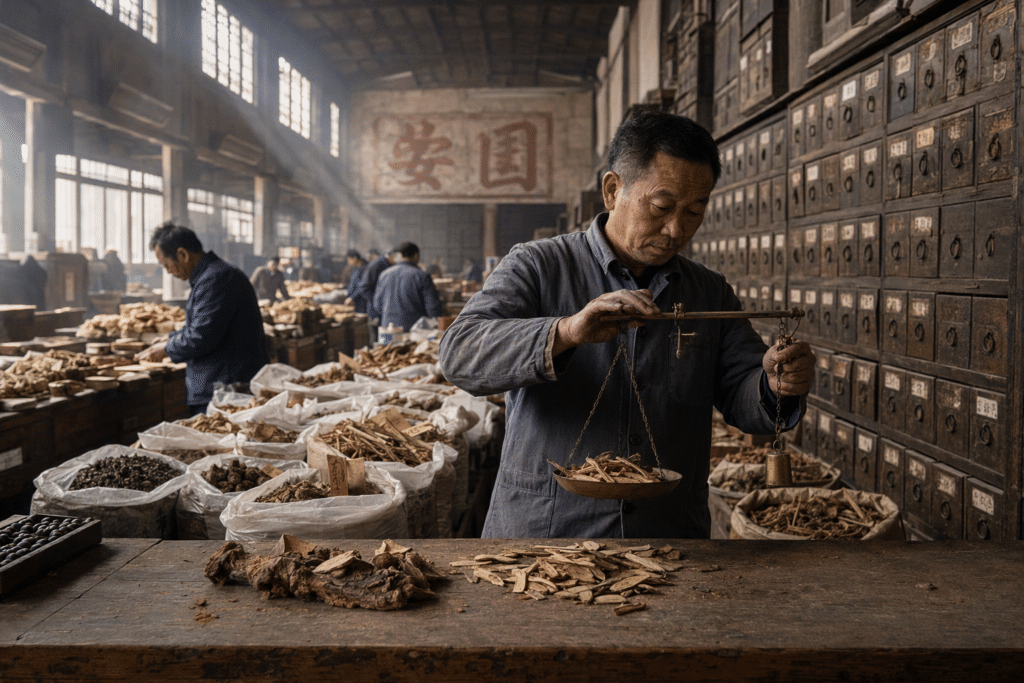
Anguo’s government identifies 金木集团 (Jinmu Group, internationally branded as JIMON GROUP) as one of the anchor enterprises in the local industrial park. In its description of the city’s development—from a centre for medicinal raw materials to a centre for pharmaceutical products—the government also refers to the group’s academic workstation Anguo government portalanguo.gov.cn. This matters because it places the company within the region’s industrial policy, not merely alongside it.
The manufacturing base has a traceable history as well. The group brings together four pharmaceutical businesses associated with long-standing brands: 保定中药 (Baoding Traditional Chinese Medicine), 安药集团 (Anyao Group), 御本堂 (Yubentang) and 颐寿堂 (Yishoutang). The company website reports approximately 300 medicine registration certificates, 56 national patents and 11 exclusive products Jinmu Group official websitejinmujituan.cn. These headline totals remain company-reported and should be checked against individual records where a specific number matters.
The Jinmu International Health Industry Park, with first-phase investment reported at more than CNY 1 billion, has also been included by provincial authorities among early national demonstration bases for traditional Chinese medicine health tourism Hebei Department of Culture and Tourismwhly.hebei.gov.cn.
A separate chronology on this site follows the group’s development from a small factory to a broader research organisation, so I will not repeat it here. See JIMON GROUP History: From a Small Factory to a Global Research Group. For the current question, the important conclusion is narrower: the first component of the strategy is a built industrial base with a visible role in the local economy, rather than a future aspiration alone.
Hub two: international operations that leave a regulatory trail
I was more sceptical about the international hub. Chinese companies often announce “global expansion” without leaving much verifiable evidence abroad. In this case, the documentary trail is more substantial than I expected.
In July 2026, Hebei Daily (河北日报), the provincial newspaper, published a detailed report on Hebei pharmaceutical businesses entering overseas markets and used JIMON GROUP as a major case study. The report describes overseas corporate and operating structures across 14 countries, including Singapore, South Korea, Indonesia and Russia. It also reports that Hydnocarpus seed oil (大枫子油) is sold in Singapore and Malaysia, that nine products—including Angong Niuhuang Wan and Xihuang Wan—received Canadian registrations, and that more than 50 products obtained halal certification in Indonesia Hebei TV / Hebei Daily coveragehebtv.com.

I examined the Canadian case separately because it materially changes the picture. Canadian natural health products are subject to pre-market review and receive Natural Product Numbers (NPNs). Industry reporting lists Canadian registrations for nine products from three group businesses industry report on Sohusohu.com. This is more than a marketing statement: an individual registration can be checked with the regulator for the product concerned. It should not, however, be confused with a blanket approval of the entire catalogue or with prescription-drug status.
In May 2026, industry outlets reported the opening of a JIMON operating centre in Malaysia under a three-party arrangement involving the group, AAA International and Malaysia’s Luxor, with chairman Niu Liwei in attendance Zhixiaotang reportzhixiaotang.com. Separately, a JIMON representative in Kazakhstan appears as a registered legal entity with a Kazakh business identification number on its local website JIMON Kazakhstanjimongroup.kz.
What is confirmed, and what still needs checking? The available sources document Canadian registrations, halal certification, product sales in Singapore and Malaysia, and a legal entity in Kazakhstan. The precise functions and legal status of all 14 overseas structures still require country-by-country examination; some may be representative or sales offices rather than manufacturing facilities. Even with that qualification, the international hub has real regulatory and corporate traces rather than existing only on a presentation slide.
AI system one: a health platform said to use five million tongue images
The most unusual element is the AI health-management platform, built around analysis of tongue images (舌像). The company says the platform has launched and that more than five million tongue images have been accumulated for training its system.

Two different levels of evidence need to be distinguished here.
The first is the underlying technology. Tongue examination is one of the traditional diagnostic methods in Chinese medicine, and digitising it has become a research area at the intersection of medicine and computer vision. A 2026 educational review by Beijing’s Chinese Medicine Administration cites reported AI performance of around 88% for identifying certain tongue-related patterns or syndromes. In December 2024, three Chinese agencies, including the National Health Commission, added intelligent auxiliary diagnosis in traditional Chinese medicine to an official list of priority AI healthcare scenarios Beijing Chinese Medicine Administrationzyj.beijing.gov.cn. Government district portals also describe systems that generate preliminary assessments from a tongue photograph and questionnaire data in seconds Zhoukou government portalzksfq.gov.cn.
The second level is JIMON’s specific platform. Here the status must remain explicit: the five-million-image dataset and the model’s claimed performance are company statements. I found no independent audit or peer-reviewed validation publication confirming those specific metrics. That does not prove that the platform does not exist; it means that its quantitative performance has not been independently established in the sources reviewed. For health-related AI, deployment and scientific validation are separate milestones. This question remains open.
AI system two: partner training as digital infrastructure
The second AI component is a system for training and supporting business partners. The stated goal is to serve a geographically distributed network: a digital assistant could take over part of the work previously done by in-person trainers, including product information, customer-work scenarios and onboarding for new partners.

Independent sources about this component are limited. It appears to be the newest part of the strategy, and its documentary trail is still developing. There is, however, a wider industry context: since 2024, Chinese health-sector policy has encouraged AI adoption, and many large corporations have been transferring internal training into AI-supported formats. For a business operating through a licensed direct-selling model, reducing the cost of training and supporting partners in remote areas could have practical economic value.
The appropriate conclusion is therefore restrained: the concept fits the sector’s direction, but the specific system appears to be at an early stage of implementation. Its functionality and results should be revisited as independent information becomes available.
JIMON Selection Mall: a tangible connection between the parts
Between commerce and AI sits JIMON Selection Mall (金木甄选), the company’s digital shopping platform. This is one of the most concrete parts of the strategy that I could verify independently.
The “金木甄选” app appears in Chinese mobile-app catalogues. According to analytics service MoonFox, it was developed by 金木甄选(济南)信息技术咨询有限公司, launched on 1 September 2025 and updated to version 1.2.7 by late October 2025 MoonFox app profilemoonfox.cn. A working web interface offers sections for the group’s own products, group purchases, product selection and training materials JIMON Selection Mall web interfacewap.jmzxhw.cn.
Technically, it is a mobile shopping application. From a research perspective, it is more significant: it establishes that the digital-commerce component exists as a product with a release date and an update history, rather than only as a strategic declaration. Industry descriptions of the platform refer to product selection, partner pricing, tools for developing a business and updates on products and company information.
The layer beneath the strategy: research and scientific infrastructure
A “commerce + AI” strategy without a research base would be an empty shell. I therefore examined the group’s research activity separately—and found some of the strongest evidence in the article here.

An academic workstation (院士工作站) was established at the group in 2016. This is a recognised research-cooperation format overseen within provincial science and technology frameworks, and Hebei Daily reported the development Hebei Daily report via an industry archivechndsnews.com. The group is also associated with the Hebei Institute of Industrial Technology for Chinese Medicinal Materials (河北省中药材产业技术研究院), which provincial authorities describe as one of the innovation anchors of Anguo’s traditional-medicine industry Hebei Department of Industry and Information Technologygxt.hebei.gov.cn.
A central example is Guanxinjing capsule (冠心静胶囊). Its protocol for a multicentre, randomised, double-blind, placebo-controlled trial was published in the peer-reviewed international journal Trials. The product is manufactured by Baoding Traditional Chinese Medicine Pharmaceutical, a group subsidiary, and the trial is listed in the Chinese Clinical Trial Registry Trials / PubMed Centralpmc.ncbi.nlm.nih.gov. In November 2023, a team led by academician Zhang Boli of the Chinese Academy of Engineering joined further development of this traditional formula with Tianjin University of Chinese Medicine and Zhejiang University, according to China Daily China Daily reportcn.chinadaily.com.cn. A sector report from April 2026 indicates the work continued Sina, Tianjintj.sina.cn.
A related article on this site examines how research can shape products: JIMON GROUP Scientific Foundations: How Research Shapes Products.
One more link connects this scientific layer to the group’s AI ambitions. In 2025, the company announced strategic cooperation with the research team at Shanghai Super Laboratory (SUPER LAB), with a focus on biosynthesis and greener organic raw-material technologies Jinmu Group official websitejinmujituan.cn.
The picture is capped by a government-level recognition. On 21 November 2025, the provincial government awarded the group the 13th Hebei Government Quality Award, a provincial quality-management award granted biennially to ten organisations Hebei provincial government noticehebei.gov.cn. This is an official government decision, not a trade-show or commercial award.
What the strategy changes in substance
The following is my analysis, rather than a fact stated by one source. The traditional model in this sector is linear: manufacture, sell through a network, then repeat. If its verifiable components are taken together, the 2026–2027 strategy describes a different structure.
The two trading hubs create a geographic network: a domestic market anchored in Anguo’s industrial cluster, alongside external markets where specific products have secured regulatory access in Canada and parts of Southeast Asia and Central Asia. The two AI initiatives are intended to create an information network: one focused on the health-service interface for end users, the other on partner knowledge and capability. Selection Mall connects the commercial and service layers through product discovery, purchasing and training.
If that model is fully implemented, the company could develop from a manufacturer with a partner network into an operator of a broader ecosystem: commerce produces data, data can help train AI systems, and AI may add value to both commerce and health-related services. That appears to be what the company means by bringing trade, digital tools, health services and training into one ecosystem.
The strength of the concept is that its foundation is not entirely virtual. The Chinese direct-selling licence was issued on 19 November 2015 China.com.cn Financefinance.china.com.cn; Canadian registrations and halal certification have been reported by provincial media; the shopping app has an identifiable release history; and research partnerships and the clinical-trial protocol have public records.
The vulnerable areas are equally visible. The performance claims for the health AI have not yet been independently published; the AI partner-training system is still developing; and the actual scope of the overseas network needs to be verified entity by entity in local registers. Those limitations do not erase the documented parts of the strategy, but they do set the limits of what can be concluded today.
Evidence status: what has and has not been established
Reported or independently documented in public sources: Anguo’s industrial base and the group’s role in local development; the 2015 direct-selling licence; nine reported Canadian product registrations; halal certification for more than 50 products; sales in Singapore and Malaysia; the launch of a Malaysian operating centre in 2026; the “金木甄选” mobile app and its September 2025 release date; the academic workstation and collaboration involving Zhang Boli’s team; and the Hebei Government Quality Award of November 2025.
Company claims still awaiting independent confirmation: the health AI’s specific metrics, including the dataset of more than five million tongue images; the full functionality and impact of the AI partner-training system; and the exact composition and role of every overseas operation.
This is the answer to the question that started the investigation. “Twin trading hubs + twin AI systems” is not simply a slogan resting on nothing. Public records, government decisions and reported regulatory steps sit under the two commercial hubs. The AI side rests on a real research paradigm and an existing digital shopping product, but its most ambitious performance claims have not yet crossed the line from company reporting to independent validation.
The next question this research raises
This review closes one question and opens another. If JIMON’s health-management AI genuinely operates on a dataset of the reported scale, validation studies should eventually appear: comparisons with clinical assessment, reproducibility results and published performance metrics. Whether such studies emerge in the next two years will be a more meaningful test of the second half of the strategy than another announcement. This is a subject worth revisiting as evidence develops.
If you have records relevant to any of these topics—product registrations, local records for overseas entities or technical material concerning the AI platform—they can help extend the investigation. Sometimes a single page from a primary source is more useful than another overview. The “Contact the author” route is one way to share such material. For ongoing discussion of source documents and checks that extend beyond the website, the “Laboratory of Algorithms” research space on Telegram continues this work between articles.
Sources
- Jinmu Group official website: group structure, brands, patent figures and cooperation with SUPER LAB — official sourcejinmujituan.cn.
- Anguo government: JIMON’s role in the local industrial cluster — government portalanguo.gov.cn.
- Hebei TV / Hebei Daily: international expansion, reported presence in 14 countries, Canadian registrations, halal certification and Singapore/Malaysia sales — provincial media reporthebtv.com.
- Hebei provincial government: decision on the 13th Government Quality Award, dated 21 November 2025 — government noticehebei.gov.cn.
- Hebei Department of Industry and Information Technology: innovation platforms in Anguo — department reportgxt.hebei.gov.cn.
- China Daily: seminar and research development for Guanxinjing capsule with Zhang Boli’s team — China Dailycn.chinadaily.com.cn.
- Trials (BMC): protocol for the Guanxinjing capsule randomised controlled trial — full research recordpmc.ncbi.nlm.nih.gov.
- Beijing Chinese Medicine Administration: AI-assisted traditional Chinese medicine scenarios — public-sector reviewzyj.beijing.gov.cn.
- MoonFox: app profile and release history for “金木甄选” — app analytics recordmoonfox.cn.
- Zhixiaotang: opening of the Malaysian operating centre — industry reportzhixiaotang.com.
- China.com.cn Finance: direct-selling licence coverage — finance reportfinance.china.com.cn.
- Hebei Department of Culture and Tourism: JIMON International Health Industry Park — government sourcewhly.hebei.gov.cn.
Editorial note: This is an independent review, not an official publication of JIMON GROUP. Company statements, third-party reporting, public records and author analysis are identified separately. Information about health-related AI is not medical advice and should not be treated as a substitute for professional diagnosis.
Research keys
Browse the topic archives for this article.