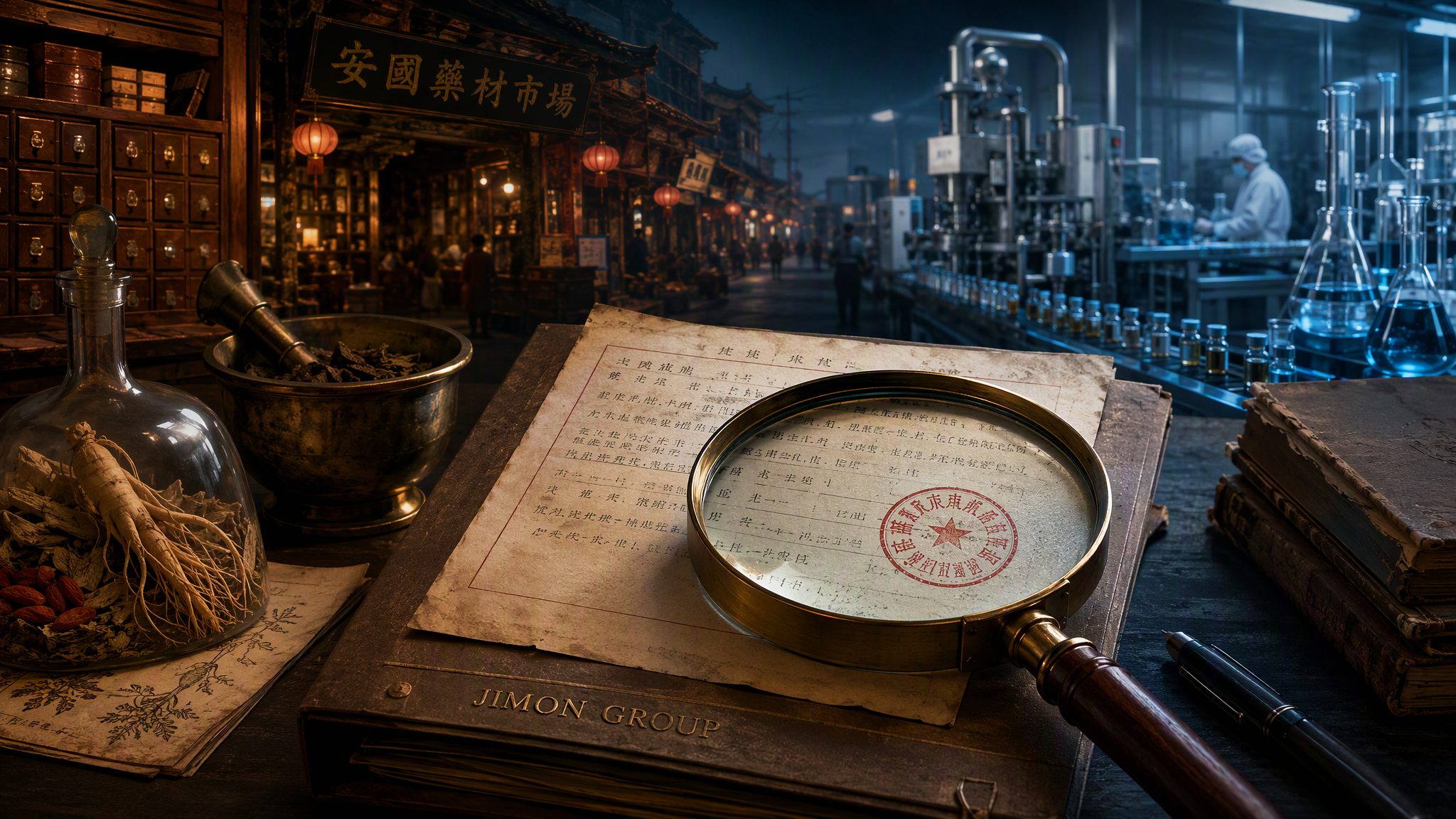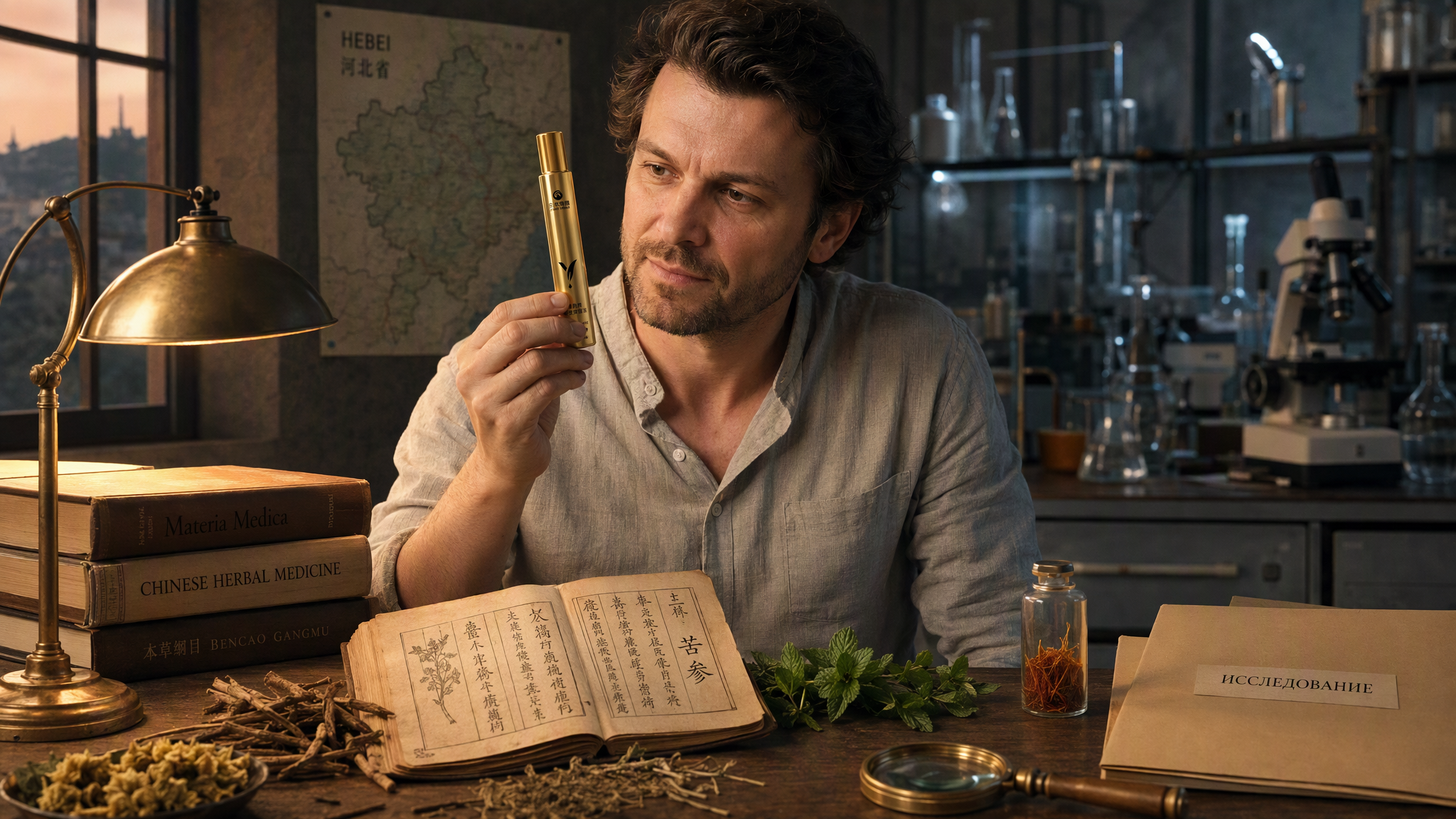
Some films tell a story. Others put things to the test.
I see the video “JIMON GROUP — The Great Silk Road of the 21st Century,” which you will find on this page, as the second kind. Before you press play, I want to explain why the film took this particular form—and what you can take away from it if you watch carefully.
Where it began: a road that does not appear on maps
When I began working on this material, I deliberately did not start with the company. Here is why.
Every modern pharmaceutical manufacturer faces a question older than the economy itself: how does knowledge become value? For thousands of years, a route crossed Eurasia that we have come to call the Great Silk Road. But “silk” is only a beautiful name. Along those roads travelled herbs, spices, formulas, technologies and, above all, knowledge—from one civilisation to another.
The film’s first section is about this idea: the Silk Road never really ended. It simply changed form. That idea becomes the thread running through the entire film, as you will see by the final minutes.
Anguo: a city whose history is written in plants
The film then takes you to a place about which surprisingly little has been written online in Russian. Anguo is a city in Hebei Province that government sources call the “millennial capital of medicines.”
I wanted to show that this is not just a decorative metaphor. Anguo has infrastructure built up over centuries: collecting, classifying, drying, storing and processing herbs, developing formulas and passing on knowledge. Together, these practices turned an ordinary plant into an object of knowledge—and knowledge into a commodity.
This is where the film approaches its central question: what happens to an ancient tradition when the age of individual masters gives way to the age of technology?
Why JIMON emerged there
The company was founded in 1993. It is not a thousand years old, and the film says so plainly. But it emerged within a pharmaceutical culture with a thousand-year history and became part of the process of turning traditional medical knowledge into a modern manufacturing system.
Here I deliberately separate two claims that are often mixed together: JIMON did not create everything from scratch—it brought an existing heritage together. Four traditional Chinese medicine brands with histories of more than a century became part of the group. The sequence is: a thousand-year-old environment → centuries of tradition → modern enterprises → JIMON.
The patent archive: where the film becomes evidence-based
This is perhaps my favourite part, and the part worth staying for even if you are tempted to pause the film after the historical sections.
A company’s history can be read not only in presentations, but also in its patent archive. In the film, I show how the documents form a sequence of technological development:
— CN102101824A (2010): a method for producing borneol;
— CN104817431B: a borneol synthesis technology representing another level of development;
— CN105037098B: a process for producing crystalline borneol; the patent is listed as Active;
— CN104697983A (2015): a method for determining lead, cadmium, arsenic and copper in Chinese medicinal materials.
The last patent is especially revealing to me. For thousands of years, people assessed medicinal plants with their eyes—through colour, smell, shape and a master’s experience. Here, the plant is asked a question that the eye cannot answer: what else is inside it? And a technological answer is developed.
The map expands further:
the bone-density functional product CN109601880B; a capsule for chemical liver injury, CN109349640A; a gastrointestinal drink, CN104799392B; lycopene with vitamin E, CN116602403B; and, in 2024, a tea containing Luo Han Guo, CN116549536B, dated September 2024.
A patent is not interesting merely because it bears a seal. It reveals the problem the company was trying to solve: how to turn traditional knowledge into a reproducible technology.
From seed to capsule: eight stages you will see
In the middle section of the film, I follow the full production route—from growing the raw material to the moment a capsule reaches a person’s hands. You will learn:
— how soil, water and environmental conditions are monitored across owned and contracted growing areas;
— why the company patented CN215140207U, a system for returning substandard material for reprocessing, even at the raw-material milling stage;
— how quality control works in laboratories where measurements are made down to millionths of a gram;
— what the “one centre + six bases” structure means and where the production facilities are located, including 8 Jinmu Street in Anguo;
— which products are covered by a manufacturing certificate valid from April 2025 to April 2030: tablets, capsules, granules, pills, syrups and tinctures;
— who is behind the development: an R&D team of more than 90 specialists, nearly 2,000 group employees, an archive of more than 16,000 formulas, and the company’s reported cooperation with Shanghai SUPER LAB in biosynthesis;
— what China’s official registration numbers, 国药准字, mean, and why the JIMON production network has around 300 of them, including specific examples: Huoxiang Zhengqi Shui (Z13021935), Compound Danshen Tablets (Z13021209), Liuwei Dihuang Wan (Z13021244) and others.
An important caveat: I make this distinction in the film as well—some data come from company statements, while other details come from documents that can be checked. My goal was to show the difference rather than merge everything into a single promotional narrative.
When tradition meets artificial intelligence
If you think the technological story ends with patents, you are mistaken—the film proves otherwise.
In July 2026, an official Hebei publication described Jinmu Group as an Anguo enterprise with a 33-year history. That article introduced two developments that cast the broader story in a different light: AI 四诊仪, an artificial-intelligence system for diagnosis using the four traditional Chinese medicine examination methods, and the intelligent health-management platform 金木 AI 小质.
Both were developed with China Zhongke Xinchang and the Institute of Microelectronics of the Chinese Academy of Sciences.
Consider the change: a thousand years ago, a physician made a diagnosis using experience, hands and eyes. Today, the same body of knowledge is beginning to interact with artificial intelligence. The question has changed. The underlying aspiration has not.
A new geography: where the route is heading today
The next section of the film is about the map. JIMON reports a presence or partnerships in Singapore, South Korea, Japan, Australia, Canada, Indonesia, Malaysia and Slovakia. Beyond that, new horizons are unfolding now:
— Kazakhstan: an official opening in June 2026;
— Kyrgyzstan: the official opening has taken place;
— Uzbekistan: the next point on the route;
— Russia: an opening planned for autumn 2026;
— Mongolia: late autumn 2026;
— Europe: 2027.
The routes fan out from Anguo in every direction, much as caravan routes once did a thousand years ago. Now, what travels along them is not just merchandise, but also technology, knowledge and people.
The film’s most unexpected turn
And now, the part that may be the reason you opened this page.
At first, you may think the film is about China. Then you may think it is about medicine. Then pharmaceuticals, technology and global expansion. And then you realise that, all along, we have also been talking about a network. About people. About how something valuable is passed from one person to another.
An ancient caravan moved along a chain: person → person → city → city → country. A trader carried more than goods; they carried reputation, trust and knowledge of what they were transporting.
A modern network is built according to a similar logic: person → person → community → market → country.
Here I deliberately avoid making grand claims. The film presents this as a question to think about: might network business be a modern social version of the ancient trade route? Might each partner be part of a new caravan of the 21st century—a caravan carrying not silk and spices, but a product created at the intersection of a thousand-year tradition and modern technologies?
I will not present this parallel as a proven fact. But I cannot dismiss it either—too many elements seem to align.
What you will take away from watching
In brief, the film offers:
1. Historical context—why Anguo is called the millennial capital of medicines and what that actually means.
2. A documentary foundation—specific patent, registration and certificate numbers that you can verify independently.
3. An understanding of scale—56 national patents, around 300 government registrations, more than 16,000 formulas and the “one centre + six bases” structure.
4. A technological horizon—how traditional Chinese medicine is being connected with biotechnology and artificial intelligence.
5. The geography of expansion—where the company is present and where it says it plans to go in the coming years.
6. A question for yourself—whether to remain a user of a distinctive product or become part of a story being written right now.
The ending that is really a beginning
The film ends with a thought I cannot disagree with: the Great Silk Road never truly ends. It simply changes form. First, it was a road of camels and caravans. Then it became a network of trading cities, then pharmaceutical factories and laboratories. Today, it is a global technology company and a community of people around the world.
But beyond that lies a territory no polished presentation, certificate or scientific paper can replace: human experience.
A thousand years ago, people travelled this route carrying knowledge about plants. Today, technologies travel along it. And perhaps the most interesting part of this story has not even begun. We will see what happens next together.
I know this article and the film leave questions behind. That is normal—research does not end when a video ends. If you have a document that could add to or change this picture, if you have found a discrepancy in a patent number, or would like to discuss a specific part of the film, write to me. Sometimes a single page advances an investigation more than ten more paragraphs.
If you want to explore these subjects more deeply—with documents, archival discoveries and material that does not appear on the website—visit the “Laboratory of Algorithms.” That is where this story continues between publications.
Research by Yuri Vakhrushev.
JIMON GROUP. The Great Silk Road continues.
Research keys
Browse the topic archives for this article.