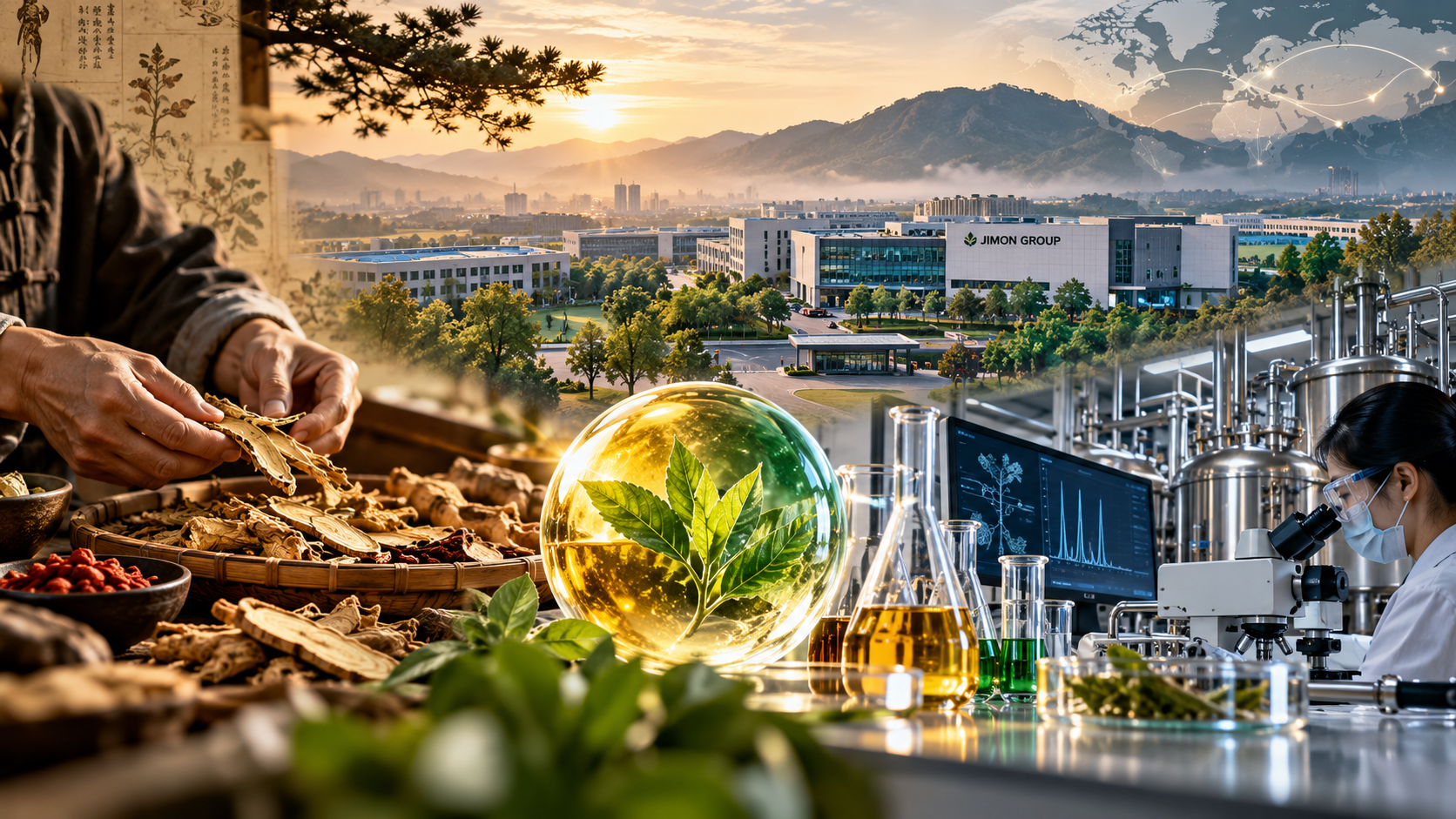
This article did not begin with a polished promotional video or a corporate press release, but with one dry line in a government document. When I started checking what really stands behind JIMON GROUP’s claim of “in-house manufacturing,” I expected to find the usual set of marketing phrases. Instead, the first serious lead was an official notice from the Beijing Municipal Medical Products Administration—a document recording the results of inspections at manufacturing facilities. Such notices are not intended for a broad public audience, which makes them particularly informative.
One line is easy to overlook: the registration holder 北京御本堂控股集团有限公司 (Beijing Yubentang Holding Group, one of the companies integrated into JIMON GROUP) passed GMP compliance inspections in two areas—liquid dosage-form manufacturing at its Beijing site and traditional Chinese medicine raw-material extraction (中药提取) at the extraction workshop in the Jinmu Industrial Park in Anguo. The address is specific: 8 Jinmu Street, Jinmu Industrial Park, Building 6. The inspection took place from 30 March to 2 April 2021, and the result was “compliance inspection passed.”
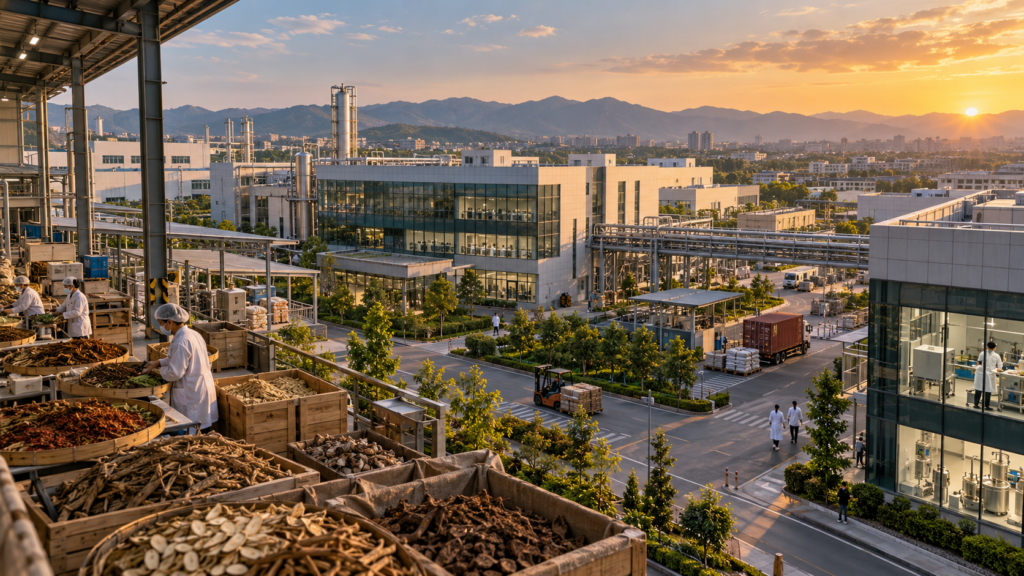
DOCUMENT TRACE Source: the Beijing Municipal Medical Products Administration’s official notice on the results of GMP compliance inspections (yjj.beijing.gov.cn). What it confirms: the existence and government inspection of a specific manufacturing facility—the TCM extraction workshop in Jinmu Industrial Park in Anguo. What it does not confirm: the current status of every production line operated by the group. The document concerns one inspection of one specific facility.
That single line was where I began reconstructing JIMON GROUP’s full production cycle, from medicinal-herb plantations to the finished product. The central question of this article is: where does JIMON manufacturing use traditional methods rooted in the millennial history of Anguo, the “capital of medicines”; where does it use modern technologies; and how is quality control maintained at the point where those two worlds meet?
The short answer that can already be given is this: documents allow the group’s production chain to be traced from the raw-material base to finished dosage forms. Traditional and modern methods do not compete with one another; they are used in different parts of the chain, following a specific technological logic. One limitation should be stated at the outset: some information appears only in company statements and industry publications close to the company, and I will distinguish those claims from independently confirmed facts throughout the article.
Anatomy of the system: one park, six bases, one research centre
To understand JIMON GROUP’s manufacturing, we first need to see its geography. According to the company and industry publications, the group is organised around a “1+6+1” model: one principal industrial park in Anguo, Hebei Province; six production bases in China and abroad; and one research centre in Shanghai. The purpose of this architecture is to create a closed, full-cycle system encompassing medicinal raw-material cultivation, primary processing, extraction of active constituents, production of finished dosage forms and distribution.
The flagship facility is Jinmu International Industrial Park in Anguo. Its scale has independent support: in 2021, Xinhua described the park as covering 305 mu (about 20.3 hectares) and having a structure of “one park, two institutes, five zones and two centres.” The complex includes a traditional Chinese medicine culture museum, a research exhibition, a botanical area for medicinal plants, and a production and logistics zone open to visitors. In January 2019, the park received AAA tourist-attraction status and was also included among the first national demonstration bases for health tourism related to traditional Chinese medicine.
RESEARCH NOTE Why is tourist status relevant to an article about manufacturing? A park that the state presents to visitors as a showcase for the industry is a facility whose infrastructure has been made publicly visible. A production site behind glass cannot be convincingly imitated for years: the extraction workshop inspected by the Beijing authority is located here.
The location itself also deserves context. Anguo is not an arbitrary dot on the map. It is known as the “millennial capital of medicines” (千年药都), a major historical centre for the trade and processing of medicinal herbs in China. According to Xinhua, an industry cluster attracting major Chinese pharmaceutical players developed here. JIMON GROUP is not simply a visitor to this cluster; it is one of the companies helping shape it.
How the company grew from local manufacturing into this structure is a separate story, reconstructed from registries and documents in my article “JIMON GROUP: From a Small Manufacturing Operation to a Global Research Group.” Here, our focus is different: how the production line itself works.
The first layer of manufacturing: raw materials that are grown, not merely purchased
Traditional Chinese medicine manufacturing begins not in a factory, but in a field. The quality of the finished product is determined before any machine is switched on: by the plant variety, the soil, the harvest period and the method of initial drying.
So the first question I put to the sources was simple: where does JIMON obtain its raw materials?
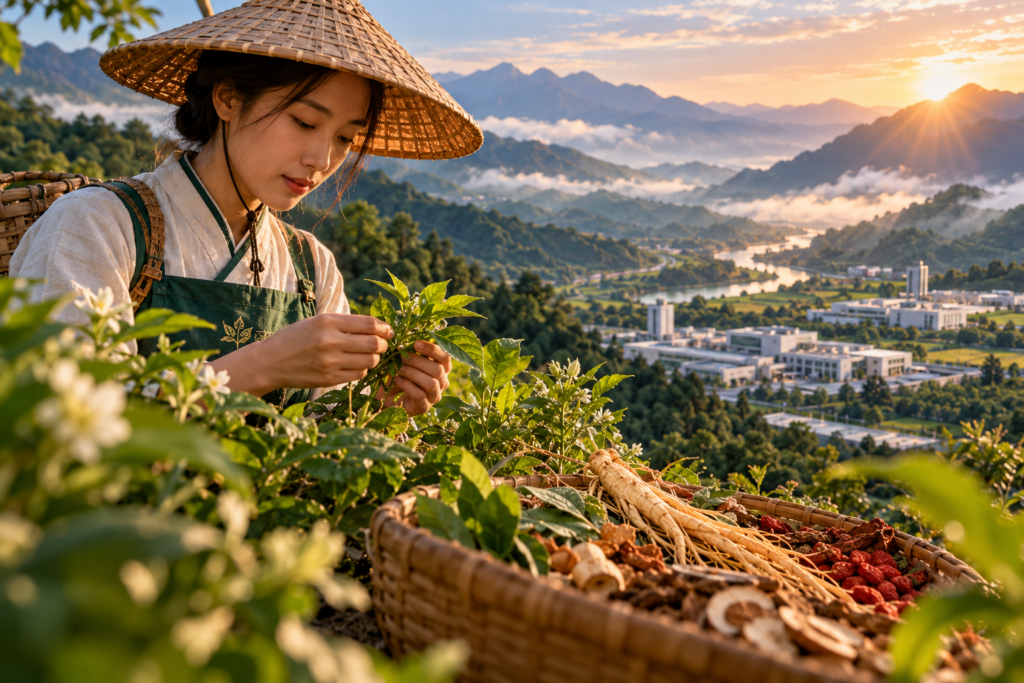
According to China Consumer News and company materials, the group has built a network of standardised plantations in regions historically associated with particular herbs: sanqi (Panax notoginseng) in Yunnan, and other crops in Inner Mongolia and Hainan. The company’s official website gives a combined area of “more than 10,000 mu” for its GAP bases. GAP (Good Agricultural Practice) is a government standard for growing medicinal raw materials. It regulates everything from site selection and planting material to harvesting and initial processing.
I would classify these details honestly as company claims, partially supported by industry publications: I have not yet verified the exact area or a complete register of all plantations against public government databases. There is, however, an independent signal that indirectly supports JIMON’s position in the raw-material segment. In June 2026, the 28th International Medicinal Raw Materials Festival in Anguo saw the establishment of a nationwide alliance of leading medicinal-herb supply-chain companies. Jinmu Group joined the alliance alongside major players such as Yunnan Baiyao. The Hebei Provincial Health Commission reported the development. Alliances at this level are not usually built around companies without a real raw-material and manufacturing base.
It is also notable that, at the same festival, academician Zhang Boli—a scholar whose academician workstation operates within JIMON GROUP—called for standardised GAP plantations to be developed as the foundation of industry quality. This overlap in priorities does not prove anything on its own, but it helps show the direction in which the broader ecosystem, of which the company is a part, is moving.
The traditional zone: what paozhi is and why it matters
Now to the most interesting part: the point where a thousand-year tradition enters a modern factory not as decoration, but as technology.
Raw herbs arriving from a plantation are not yet medicine. Between the plant and the finished preparation lies paozhi (炮制), the traditional processing of medicinal materials. It can include cleaning, cutting, roasting, steaming and treatment with auxiliary substances such as wine, vinegar, honey or saline solution. Paozhi changes the properties of the raw material: it enhances a desired action, reduces toxicity and directs the effect of the preparation. It is neither handicraft for its own sake nor ritual; it is a pharmacologically meaningful technology refined over centuries of practice.
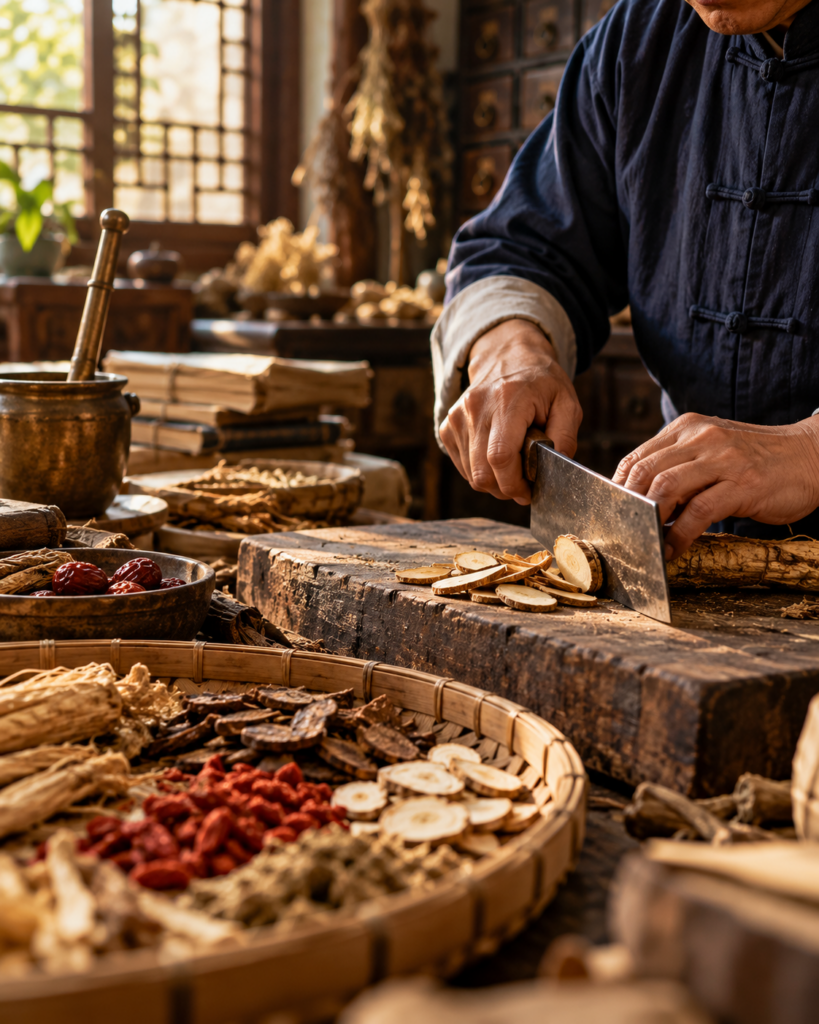
Here is a finding that changes the scale of the story. Anguo’s medicinal-material processing and preparation technique (安国中药材加工炮制技艺) has officially been included in Hebei Province’s fifth list of intangible cultural heritage, under the category of traditional medicine. This is recorded in a government register: heritage status means that the state recognises the technique as distinctive and worthy of preservation. Anguo also preserves the “Four Unique Arts of Qizhou” (祁州四绝), advanced processing skills that, according to the provincial culture department, require years of apprenticeship. For example, producing “cloud slices” from antlers involves more than ten operations, and mastering the precision of the knife may take five or six years of practice.
SIGNAL Here is a rare detail that is easy to miss: the company is based in a city whose production technique is itself protected cultural heritage. “Traditional methods” at JIMON GROUP are not simply brochure language; they refer to a specific technique with official status and a living tradition of skill transfer.
Yet the city’s heritage alone says nothing about a particular company. The next step is therefore to look at enterprises that have become part of the group. According to Jinmu’s official website and industry publications, the group integrated four long-established pharmaceutical brands: Baoding Traditional Chinese Medicine (保定中药), Anyao Group (安药集团), Yubentang Holding Group (御本堂) and Yishoutang (颐寿堂). With them, classical formulas, preparation technologies and—most importantly—the people who know how to use them became part of a modern manufacturing system.
The most illustrative example is Baoding Traditional Chinese Medicine Pharmaceutical Factory. According to its official website, it is the original developer and manufacturer of 43 classical TCM medicines used in clinical practice, including nationally known products such as Huoxiang Zhengqi Shui (藿香正气水) and Niuhuang Jiedu Tablets (牛黄解毒片). The factory is designated a national high-tech enterprise, has a Grade A research institute in Hebei Province, five invention patents and 34 utility-model patents. It is now wholly owned by Jinmu Group. In other words, the “tradition” within JIMON is not an abstract idea of continuity; it is a specific legal entity with specific formulas, patents and production lines.
The modern zone: extraction, GMP lines and the story of a low-temperature technology
A classical formula and paozhi expertise determine what to manufacture. But producing it on an industrial scale, batch after batch, with reproducible quality, depends on modern pharmaceutical technology.
Industry publications report that production bases across the group contain GMP-compliant lines that manufacture a broad range of dosage forms: prepared herbal pieces (饮片, processed raw materials for decoctions), pills, tablets, granules, oral liquids and medicinal borneol. Government documentation supports part of this infrastructure: the Beijing authority’s notice mentioned at the start of this article records the GMP compliance inspection of the extraction workshop at Jinmu Park and the inspection of Yubentang’s Beijing liquid-dosage-form facility.
The strongest documentary account I found of the company’s modern manufacturing methods did not come from promotional material, but from a substantial report in Hebei Daily on 22 July 2026, about Hebei’s pharmaceutical industry entering international markets. The story told by group vice-president Liu Jinshui is worth recounting in detail.
An overseas customer set a condition for a plant extract: it had to be extracted at low temperature without changing the product’s taste. The difficulty was that the usual extraction practice in Chinese pharmaceuticals involves heating to 90°C or above, sometimes to boiling point.
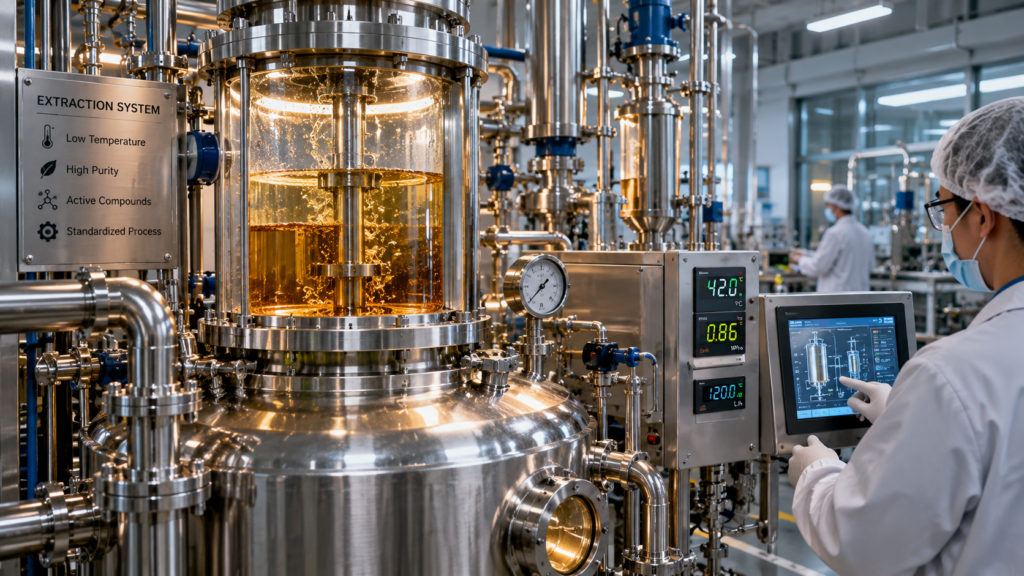
According to Liu Jinshui, the industry had no ready-made low-temperature solution. The group assembled a dedicated team that spent three months refining the process, beginning with precise control of steam temperature. It ultimately developed its own low-temperature extraction technology and then overcame two additional barriers: low-temperature blending of several extracts and high-temperature sterilisation without ionising radiation.
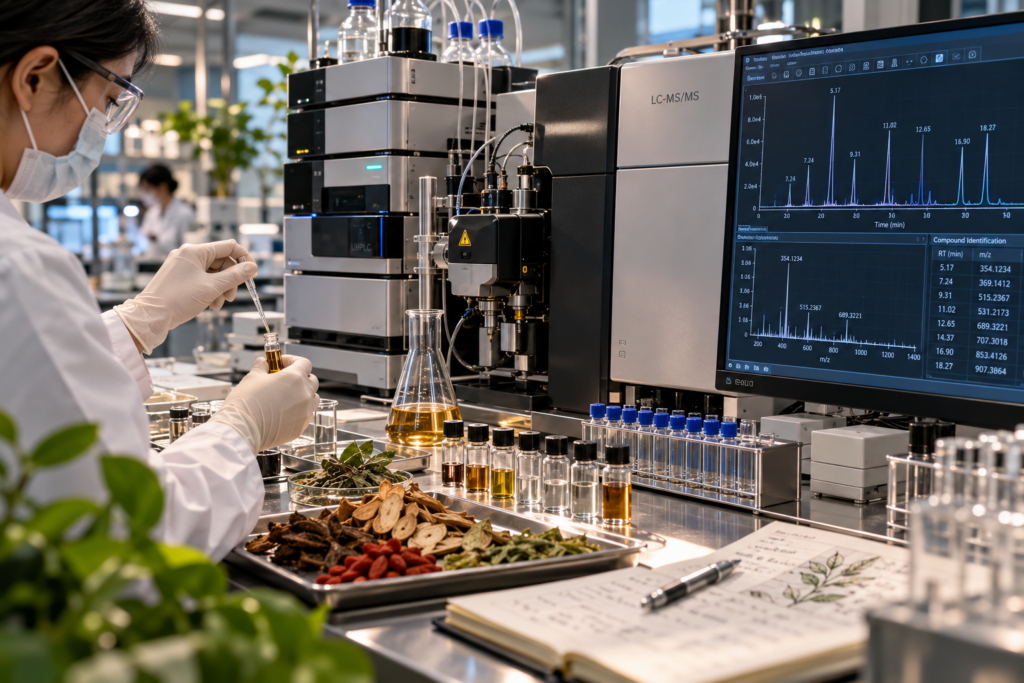
The second part of the story is even more important to me. The same customer required control of a specific active compound, but its own analytical method produced unstable results: the retention time of the chromatographic peak kept shifting. JIMON’s technical team ran hundreds of cross-experiments using equipment from different manufacturers and with different accuracy classes, adjusting separation parameters. It developed an analytical method that the customer accepted as the official quality-control method for all subsequent trade in that product. According to Hebei Daily, the group filed four national patent applications following the technological work carried out for international orders.
DOCUMENT TRACE Source: “Ji-Pharma Goes Out to Sea: A New Course,” Hebei Daily, 22 July 2026. What it supports: the company’s ability to develop non-standard manufacturing technologies for demanding international requirements, and analytical competence recognised by an external customer. Why this is stronger than advertising: the publication is an official provincial newspaper, and the account includes a named senior executive and technical details that can be checked and would be difficult to invent convincingly.
Notice the logic of this episode. Low-temperature extraction is a modern technology, but its goal is “traditional”: preserving the properties of the plant that TCM practice has valued for centuries. Sterilisation without irradiation is guided by the same principle. Modern equipment does not replace the tradition; it serves it. This may be the clearest formula for how the two worlds are combined in JIMON manufacturing: tradition defines the meaning of quality and its parameters; technology makes that quality scalable and reproducible.
Modern analytical work on classical formulas is part of the same picture. In my article “JIMON GROUP’s Scientific Foundations: How Research Shapes Products,” I discussed how methods such as chromatographic mass spectrometry can reveal the chemical composition of multi-component formulas and help assess reproducibility. In this system, manufacturing and science are neighbouring parts of the same infrastructure.
The quality system: three levels of checks and a code on every package
One key question remains: how is all this controlled? Manufacturing that brings a traditional formula into an industrial setting depends not only on production lines, but on a quality-control system.
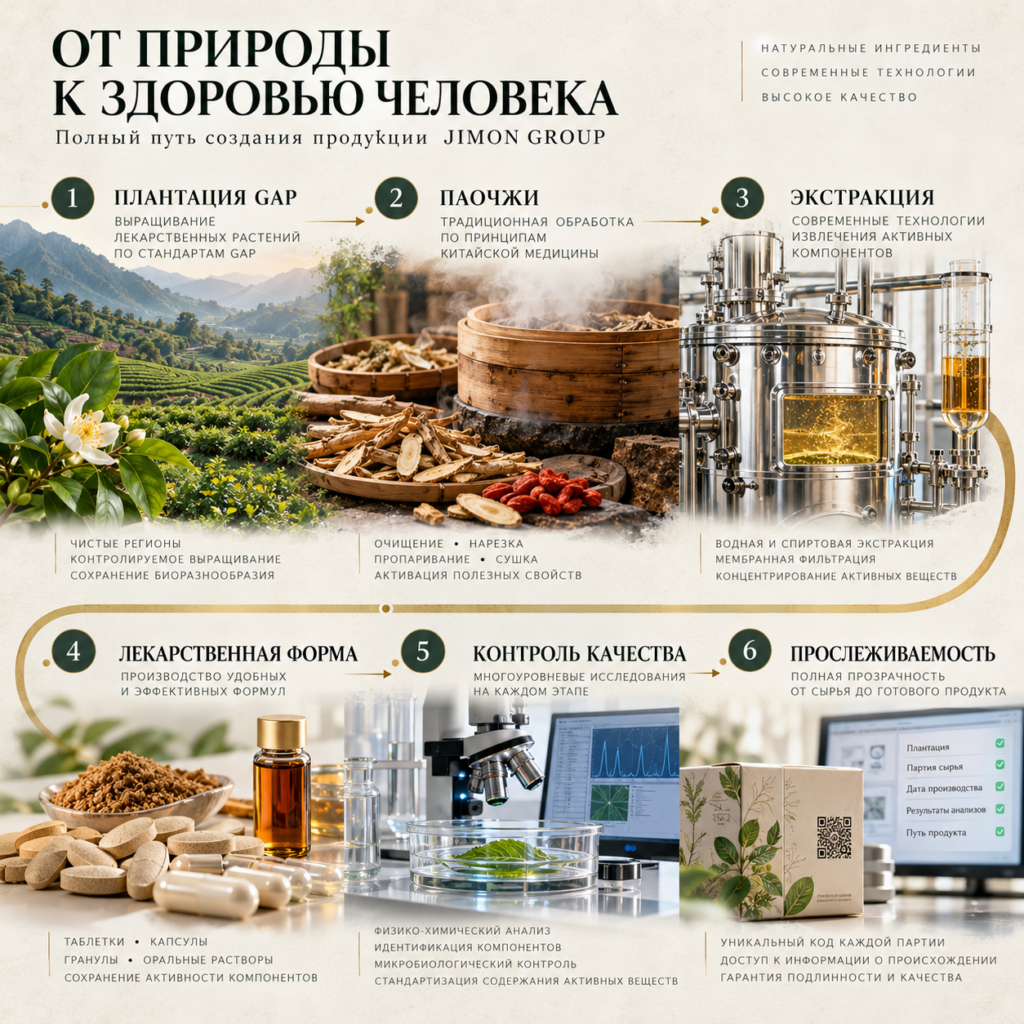
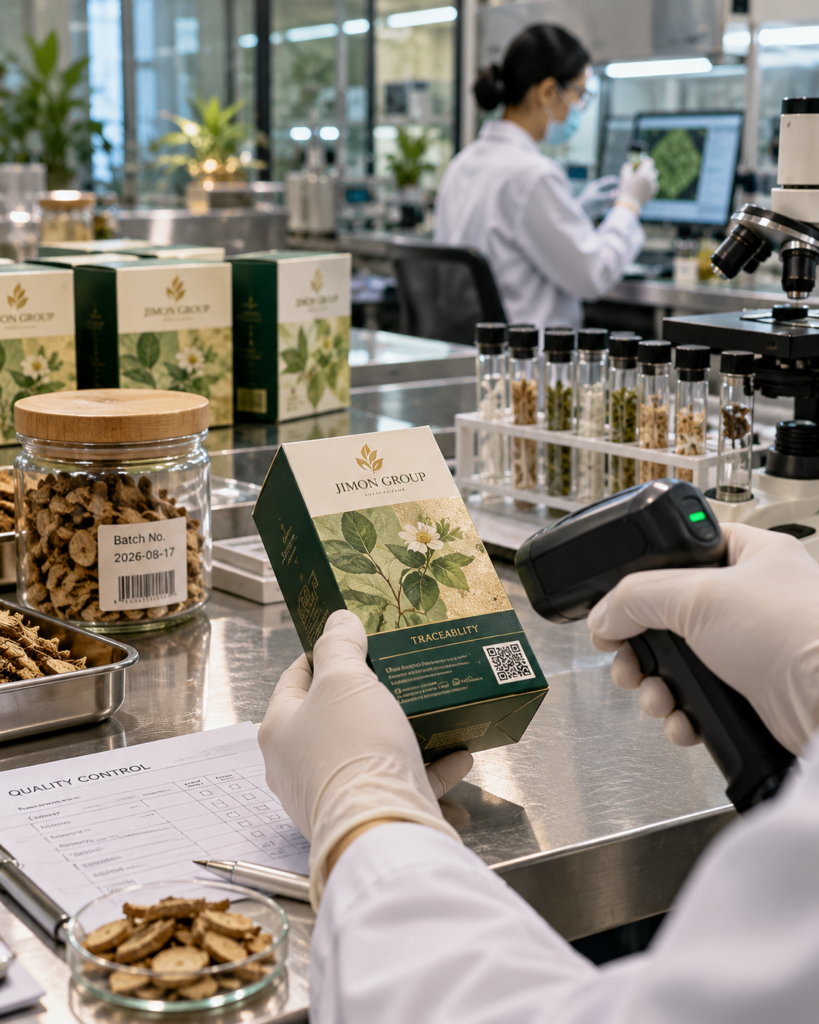
According to industry publications describing the group’s practices, JIMON uses a three-level quality-control system: incoming raw materials undergo full analysis for pesticide residues, heavy metals and active-compound content; random batch checks are carried out during production; and finished products undergo a full repeat inspection against government standards before release. A digital layer is added on top: a blockchain-based “one item, one code” traceability system that makes it possible to reconstruct the origin of the raw material, production batch, test results and distribution path for every package. These details come from industry publications and company statements. I have not found a public independent audit of the traceability system, and that is an important boundary of what is currently known.
I would highlight three institutional indicators associated with the quality system:
Fact card — Government Quality Award. The group received the Hebei Provincial Government Quality Award (河北省政府质量奖) in 2025, according to the corporate-awards register on the company’s official website. Provincial-level quality awards in China are presented after expert assessment of management systems, rather than simply on the basis of marketing applications.
Fact card — Technology-enterprise status. The official website lists the following statuses: National High-Tech Enterprise (2024), Hebei Provincial Enterprise Technology Centre (2018) and a leading agricultural industrialisation enterprise (2025). In China’s system, each of these designations requires documentary verification of the company’s manufacturing and technological base.
Fact card — International registrations as an external check. According to Hebei Daily, group products have gone through regulatory procedures abroad: nine products in Canada, halal certification for more than fifty products in Indonesia, and sales of dafengzi oil (大枫子油) in Singapore and Malaysia. Each such registration involves an external review of manufacturing documentation by another jurisdiction’s regulator.
Company statements and industry reports say the group’s laboratory holds CNAS accreditation from the China National Accreditation Service for Conformity Assessment, which means international recognition of its testing results. I am keeping this point classified as a company statement: the entry in the public CNAS register should be checked separately, and that remains a task for the continuation of this investigation.
Where the documentary picture ends
Research integrity also requires us to identify the limits of the available evidence. There are three here, and I will not gloss over them.
First: discrepancies in the figures. The group’s official website refers to 300 registrations for medicinal products, 56 national patents and 11 exclusive products. Industry publications from 2026 mention “around 300” registrations and 14 exclusive national TCM medicines. The difference may reflect the dates of the counts or what each source includes in the category “exclusive,” but it still needs to be reconciled against the NMPA register. The number of production bases also varies: some sources say six, others seven, counting overseas facilities.
Second: the status of individual certificates. As noted in the site’s foundational investigation, some GMP certificates associated with group companies appear as expired in aggregated commercial databases. This does not necessarily indicate a problem: following China’s 2019 reform, GMP oversight shifted from certification to compliance inspections. That is exactly the type of document found in the Beijing authority’s notice. Nevertheless, the current status of every production line should be checked against official regulatory notices; this remains a separate task in the research plan.
Third: the share of company-sourced information. Many details about plantations, three-level quality control and traceability come from the company or industry media close to it. That does not make them false, but it means their status is “company statement,” not “independently confirmed fact.” In this article, I have deliberately grounded the main conclusions in government documents and provincial media reporting.
OPEN QUESTION One open question emerged from this investigation: how does traceability work for a specific batch? If the “one item, one code” system works as described, scanning a single package should reveal the entire chain, from the field to the laboratory report. Testing it on a real product would be the most direct way to turn a claim into a fact.
What the investigation has established
Let us return to the opening question: is there a real manufacturing base behind the claim of a “full production cycle,” and how do tradition and technology coexist within it?
The documentary picture assembled so far is as follows. A manufacturing facility exists and is inspected by the state, as shown by the official notice recording a GMP compliance inspection of the extraction workshop at Jinmu Park. The raw-material segment has industry recognition: the group is part of a nationwide medicinal-herb supply-chain alliance alongside Yunnan Baiyao. Traditional processing is not merely a legend, but a form of regional intangible cultural heritage protected by the state; the holders of classical formulas are specific enterprises within the group, with 43 original medicines at the Baoding factory alone. The company’s modern technological level is borne out by a report in the provincial newspaper: it developed a manufacturing technology not previously available in the industry, along with an analytical method accepted by an international customer as a trade standard. International product registrations add further external reviews by foreign regulators.
The system should not be idealised: some details still need to be checked against primary registers, and I have identified which ones. But the evidence structure—government documents, provincial reporting and statuses that are not simply purchasable—supports a consistent conclusion. JIMON GROUP manufacturing is not just a marketing projection; it is a multi-layered system in which Anguo’s traditional technologies have been given a modern industrial framework. Tradition defines what quality means; technology ensures that this quality is reproduced in every batch.
This investigation addresses how the production cycle is organised, but it leaves the next question open: how does the quality system work from the inside, at the level of a specific batch, laboratory report and code on a package? If you have documents that could help examine this layer—audit results, registry records or photos showing traceability in action—please send them to me. Sometimes one page advances an investigation more than ten additional paragraphs. If you want to examine production chains together, from paozhi to chromatograms, that conversation continues in the “Laboratory of Algorithms,” where we take these systems deeper than a single article allows.
Contact the author on Telegram →t.me
Sources
1. Beijing Municipal Medical Products Administration — notice on the results of GMP compliance inspections (北京御本堂控股集团有限公司: TCM extraction, Jinmu Industrial Park, Anguo): Sourceyjj.beijing.gov.cn
2. Hebei Daily — “Ji-Pharma Goes Out to Sea: A New Course,” 22 July 2026 (low-temperature extraction, analytical method, four patent applications, international registrations, 14 countries): Sourcenews.huanbohainews.com.cn
3. Hebei Provincial Department of Culture and Tourism — fifth provincial list of intangible cultural heritage (安国中药材加工炮制技艺): Sourcewhly.hebei.gov.cn
4. Hebei Provincial Department of Culture and Tourism — material on the “Four Unique Arts of Qizhou” (祁州四绝): Sourcewhly.hebei.gov.cn
5. Hebei Provincial Health Commission — 28th International Medicinal Raw Materials Festival in Anguo and creation of the national alliance of leading supply-chain enterprises (云南白药集团、金木集团): Sourcewsjkw.hebei.gov.cn
6. Xinhua — overview of Jinmu International Industrial Park in Anguo (305 mu, park structure, AAA status and national demonstration base): Sourcenews.cn
7. Official website of 金木集团有限公司 — corporate awards, structure of the “four century-old brands,” GAP plantations and TMWS philosophy: Sourcejinmujituan.cn
8. Official website of Baoding Traditional Chinese Medicine Pharmaceutical Factory — 43 original classical medicines, patents, research platforms and integration into Jinmu Group: Sourcebdzyzy.com
9. China Consumer News — “JIMON GROUP: Quality as a Course,” 17 March 2025 (plantations in Yunnan, Inner Mongolia and Hainan, GAP and traceability): Sourceccn.com.cn
10. Industry publications on the “1+6+1” structure, three-level quality control and integration of long-established brands (2026): Sourcemt.sohu.com, Sourcesohu.com
Research keys
Browse the topic archives for this article.