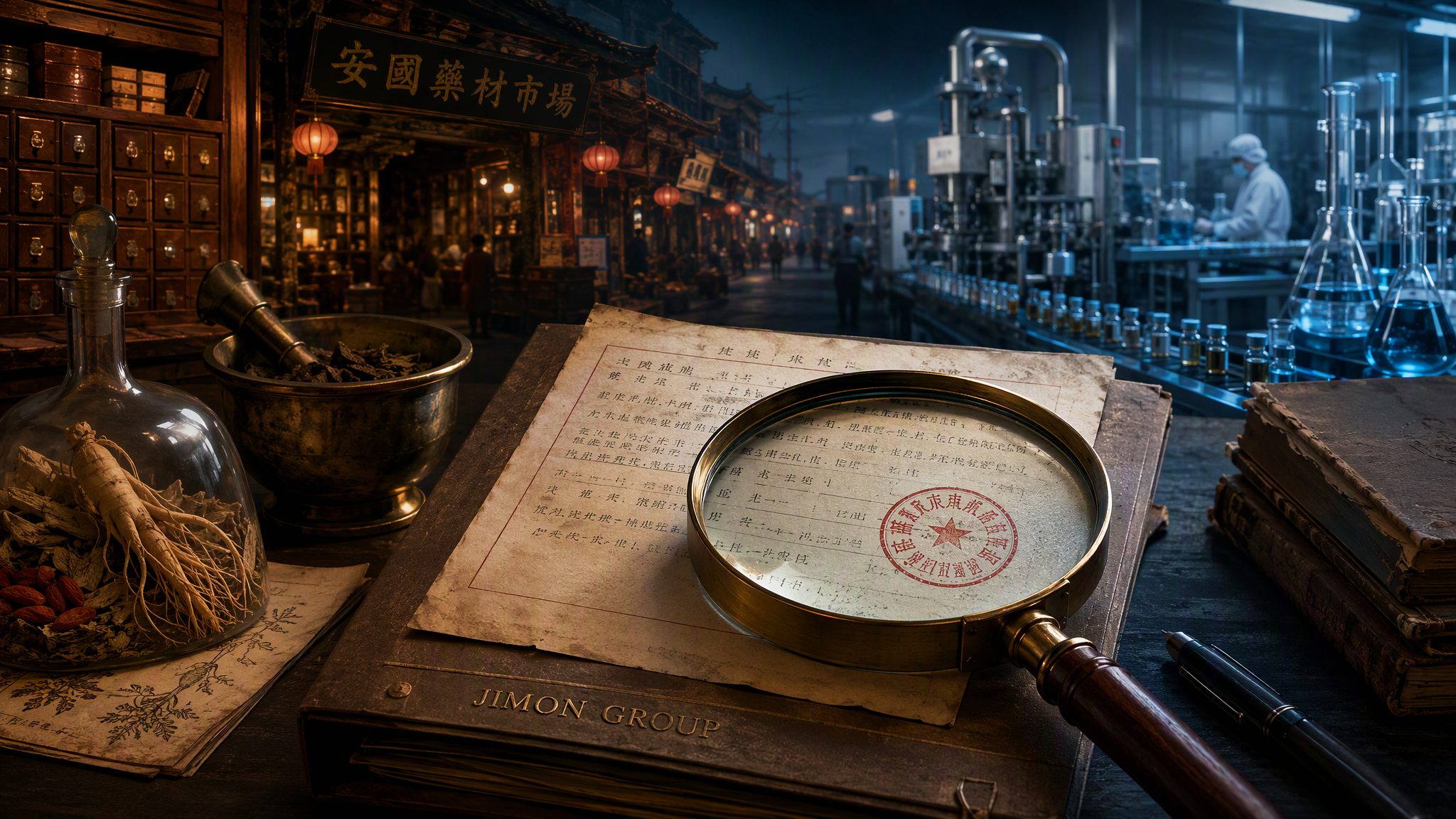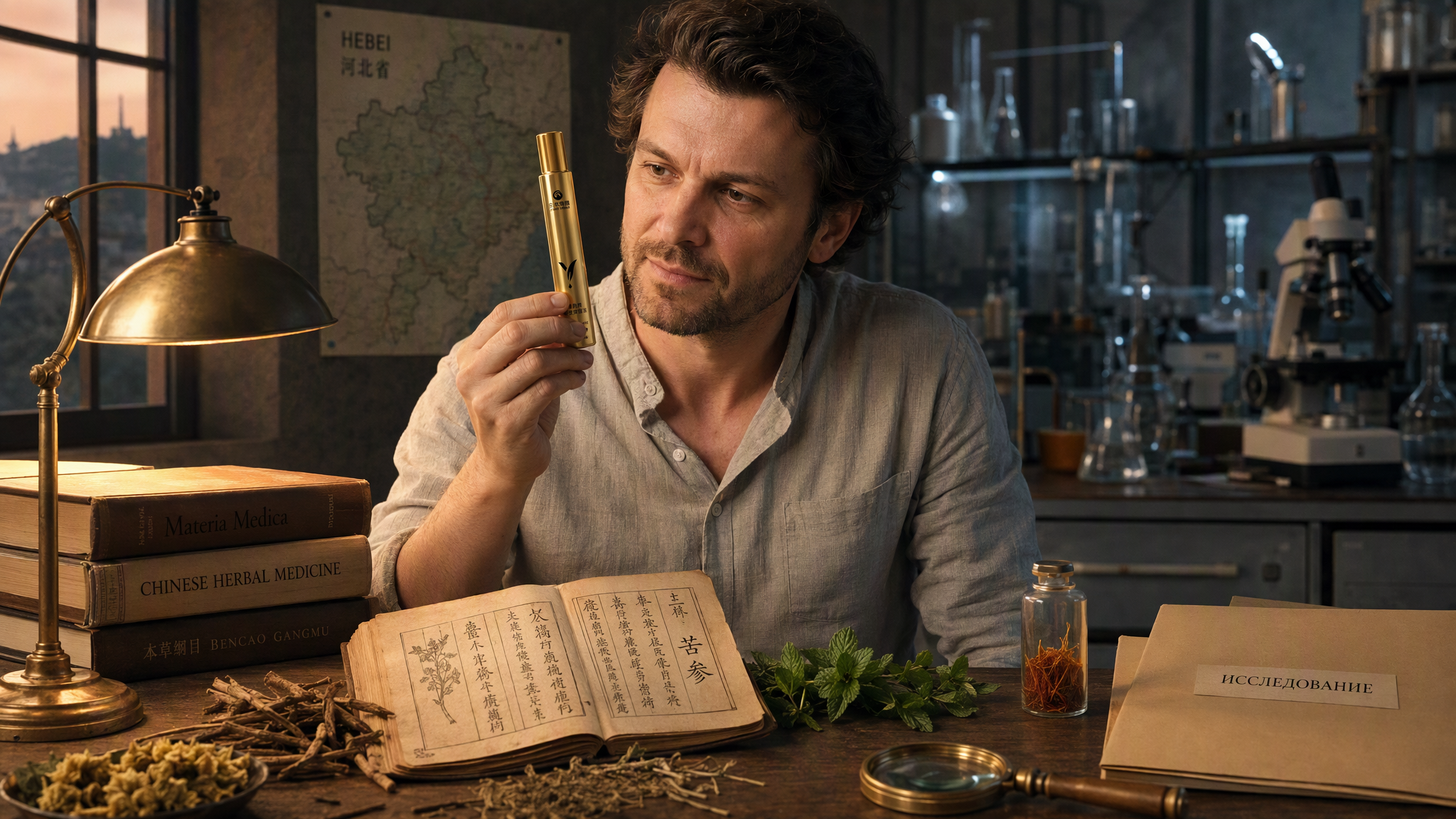
The video on this page is my full-length original investigation of a JIMON GROUP product affectionately known in Russian-speaking circles as “Sophora.” I traced this small object from ancient medical scrolls to government registers and scientific journals. In this article, I’ll explain exactly what you will learn if you watch the video to the end.
Where it began
I had an object in front of me. Small, almost weightless. Some people call it a “pencil,” others a “stick.” But I did not want to begin with an attractive name. I started with the original Chinese name—three words that turned out to be three doors: Ku Shen—the plant, Yi Jun—the action, and Ye—the form. Each door revealed something I had not expected to find.
What you will learn from the video
Seventeen centuries of history in a single bottle. The first word in the name refers to Sophora flavescens, a plant used in Chinese medicine for more than seventeen hundred years. I expected to find a line in a reference book; instead, I found a story that had passed through dynasties. Most importantly, this modest plant contains not just one active substance, but more than two hundred compounds that modern science is still studying.
Documents that can be checked. In the video, I show specific documents: a licence issued by the Hebei Provincial Health Commission on 11 September 2020; enterprise standard Q/HZT 019-2020; a state-register entry indicating that 85% of the manufacturer is owned by JIMON GROUP; 71 patents; GMP and ISO 9001 certificates; and a partnership with Tianjin University of Traditional Chinese Medicine. This is not a presentation—you can follow the documentary trail and check it for yourself.
Six plants, six stories. Sophora from the “Divine Farmer’s Materia Medica”; cassia seeds whose name literally means “clarifying vision”; the “Bo” chrysanthemum cultivar, known for its elevated flavonoid content; saffron—the most expensive flower in the world—which Avicenna prescribed in eye ointments; Senecio scandens, whose name is translated as “light for a thousand li”; and mint, whose menthol was compared with paracetamol nearly thirty years ago. In the video, each plant has its own documentary and scientific background, from the Pharmacopoeia of China to journals such as Journal of Ethnopharmacology and Nutrients.
An honest discussion of the limits. This may be the most important part. I checked the molecular weights of the active substances: all are below 500 daltons, meaning they are physically capable of passing through the skin’s stratum corneum. But do they reach the retina at a sufficient concentration? I found no direct evidence for this specific product—and I say so plainly.
The number “seven” and other promises
“Seven times more effective than acupuncture,” “cures myopia,” “dissolves cataracts”—you have probably heard claims like these. I searched for the source of each figure in patents, scientific papers and official manufacturer documents. I could not find a comparative-trial protocol supporting them. Myopia and cataracts involve changes in the shape of the eye and the proteins of the lens; no topical product can physically reverse those changes. That is not an opinion—it is anatomy.
What can genuinely be confirmed: relief from eye fatigue after a day in front of a screen, reduced puffiness, and a feeling of coolness and clarity. Improved microcirculation, muscle relaxation and a mild anti-inflammatory effect follow logically from the properties of the six plants. I leave it to readers to judge the accounts people describe as miracles. Personal experience deserves no less respect than science. They are simply different paths to knowledge.
Why the video is worth watching in full
Because it is an unusual format: neither an advertisement nor an exposé, but a researcher’s journey. From manuscripts almost two thousand years old to modern laboratories. From government registries to scientific publications. From what can be measured and reproduced to what remains at the edge of human experience.
And this is only the first product. JIMON GROUP has others, each with its own story, documents and unanswered questions. There are many more doors ahead.
If you have a document or question that could move this investigation forward, write to the author. Sometimes one page says more than ten paragraphs. And if you want to examine such subjects in greater depth alongside like-minded people, the “Laboratory of Algorithms” is open to you.
Research keys
Browse the topic archives for this article.